 Omnia Sana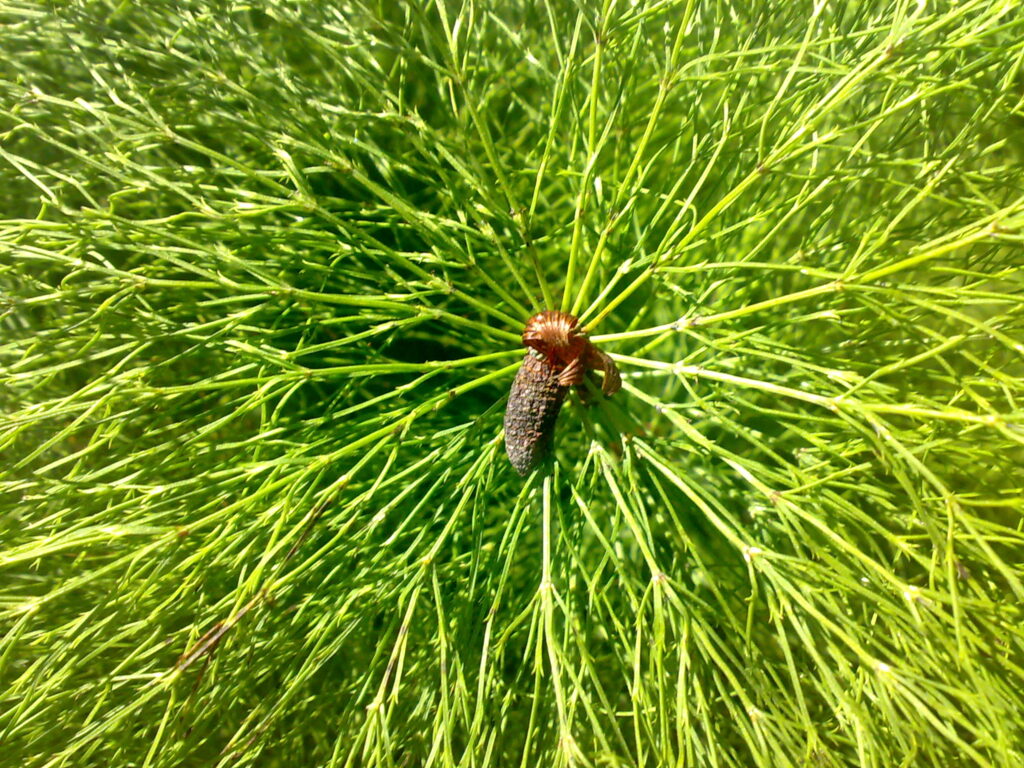
Quick ID Profile
- Latin name
- Equisetum sylvaticum
- Common names
- Wood horsetail, woodland horsetail
- Family
- Equisetaceae (horsetail family)
- Key visual ID
- Drooping whorls of branches that are themselves branched (twice-divided, lacy); loose reddish-brown sheath teeth fused into 3-4 papery lobes
- Habitat
- Damp shade - moist woodland, shaded banks and acidic grassland
- Height
- About 30-50 cm
- Look-alikes
- Shady horsetail (simple unbranched branches, dark separate sheath teeth); field horsetail
Wood horsetail (Equisetum sylvaticum) is the most graceful and the most easily recognised of the horsetails. Where most species in the genus demand a hand lens and careful comparison, this one announces itself by a single unmistakable feature: its side branches are themselves branched, and the whole plant droops in soft, feathery whorls. The reddish, papery sheaths complete the identification.
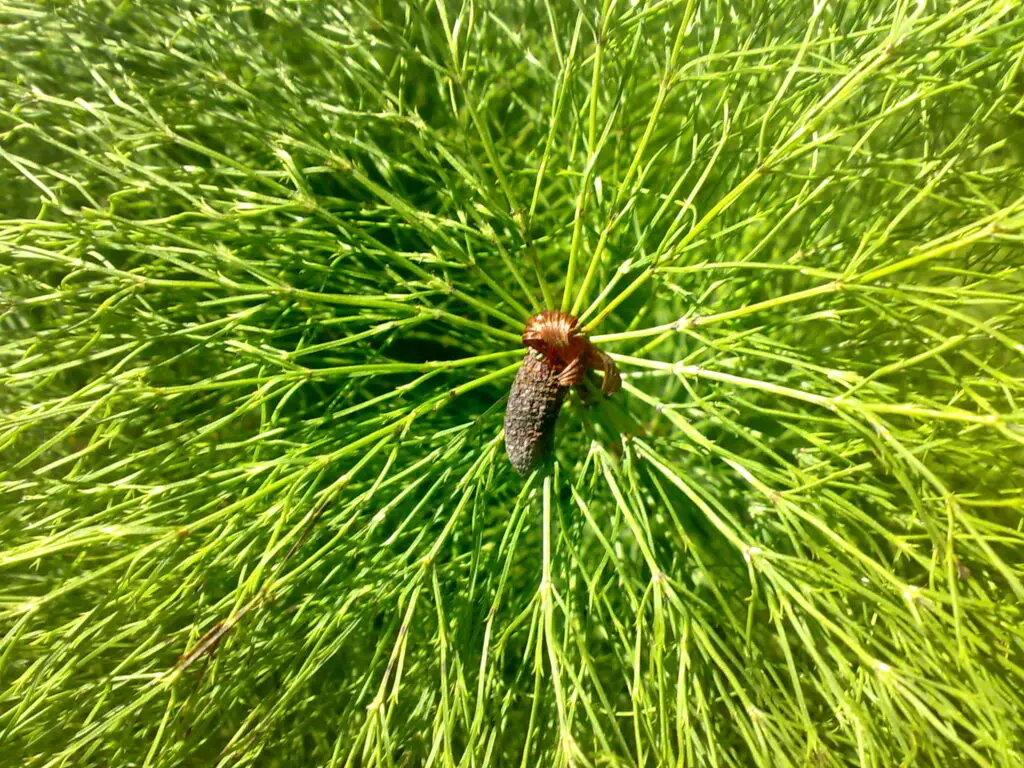
A doubly branched, drooping plant
Wood horsetail grows to roughly thirty to fifty centimetres, with erect, hollow central stems. From each node rises a whorl of twelve or more branches, and these branches are themselves divided into finer side branches. This compound, twice-divided structure is unique among the horsetails and gives the plant its delicate, almost lacy texture. The branches arch and droop outward and downward, so that a healthy plant looks like a small pale green fountain.

Sheaths
The sheaths that ring each node of the main stem are the second confirming feature. Rather than the fine, separate teeth of most horsetails, wood horsetail has sheaths whose teeth are broad, papery, and reddish-brown, fused together into just three or four lobes. This loose, chaffy, reddish collar is quite different from the dark, narrow, well-separated teeth of shady horsetail.
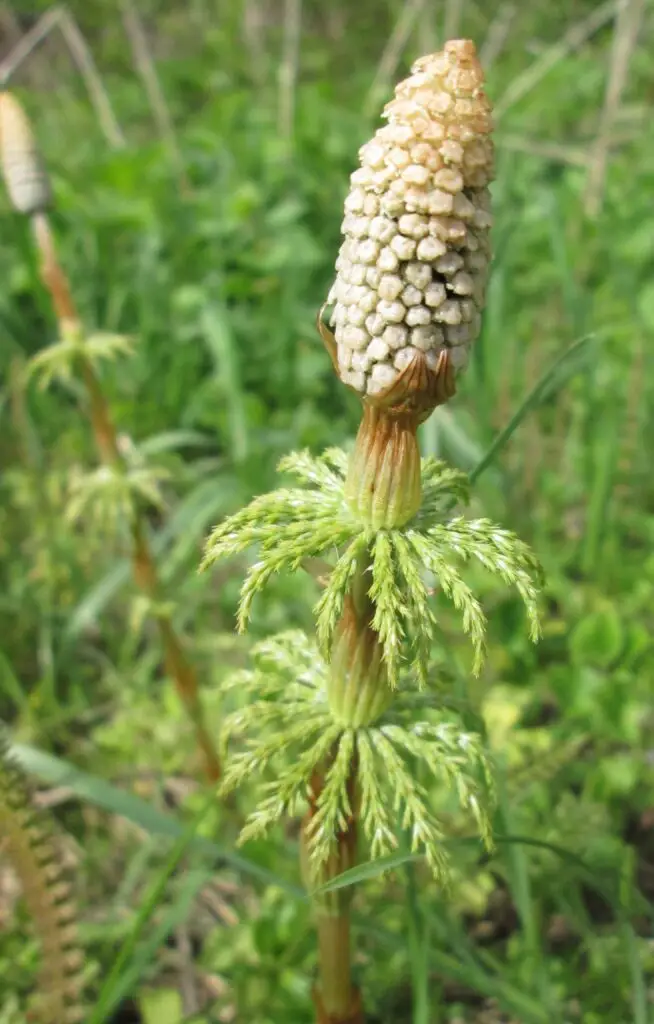
Habitat and distinction
Wood horsetail is a plant of damp, shaded ground: moist woodland, shaded banks, and acidic grassland. The closest source of confusion is shady horsetail (Equisetum pratense), but the distinction is straightforward once the branches are examined. In wood horsetail the branches are compound and drooping; in shady horsetail they are simple and unbranched. The reddish fused sheath lobes of wood horsetail further separate the two.
To name a plant as wood horsetail, look for the combination of drooping whorls of twice-branched branches and loose reddish-brown sheath lobes, in damp shade. The doubly branched branches alone are diagnostic; no other horsetail shares them. As with any wild plant, confirm more than one feature before drawing a conclusion.
Shady horsetail vs wood horsetail
| Feature | Shady horsetail (E. pratense) | Wood horsetail (E. sylvaticum) |
|---|---|---|
| Branch pattern | Simple, unbranched | Branches themselves branched (twice-divided) |
| Branch posture | Straight, spreading; delicate | Arching and drooping; lacy, fountain-like |
| Branch cross-section | Triangular | Fine and compound |
| Sheath teeth | 8-10 fine, dark, white-margined, clearly separated | Broad, reddish-brown, fused into 3-4 papery lobes |
| Typical height | Up to about 50 cm | About 30-50 cm |
| Habitat | Damp, shaded ground; woodland and streamsides | Damp shade; moist woodland and acidic grassland |
References
Botanical Society of Britain and Ireland (n.d.) ‘Equisetum sylvaticum L., Wood Horsetail’. Available at: https://bsbi.org/in-your-area/local-botany/co-fermanagh/fermanagh-species-accounts/equisetum-sylvaticum-l (Accessed: 27 June 2026).
Minnesota Wildflowers (n.d.) ‘Equisetum sylvaticum (Woodland Horsetail)’. Available at: https://www.minnesotawildflowers.info/fern/woodland-horsetail (Accessed: 27 June 2026).
Go Botany, Native Plant Trust (n.d.) ‘Equisetum sylvaticum (wood horsetail)’. Available at: https://gobotany.nativeplanttrust.org/species/equisetum/sylvaticum/ (Accessed: 27 June 2026).
Wikipedia (n.d.) ‘Equisetum sylvaticum’. Available at: https://en.wikipedia.org/wiki/Equisetum_sylvaticum (Accessed: 27 June 2026).
0 Comments
Join the conversation
Log in or create a free account to share your thoughts and vote on comments.
No comments yet - be the first to share your thoughts.