Common Names: Yarrow, common yarrow, milfoil, thousand-leaf, soldier’s woundwort, nosebleed plant, staunchweed, bloodwort, knight’s milfoil, devil’s nettle
Genus: Achillea
Parts Used: Aerial parts, Flower, Leaf
Medicinal Actions: Styptic (haemostatic), Vulnerary (wound healing), Astringent, Anti-inflammatory, Diaphoretic, Antispasmodic, Bitter digestive tonic, Antimicrobial
Preparation Methods: Poultice, Tea/Infusion, Tincture, Salve, Styptic powder
Summary:
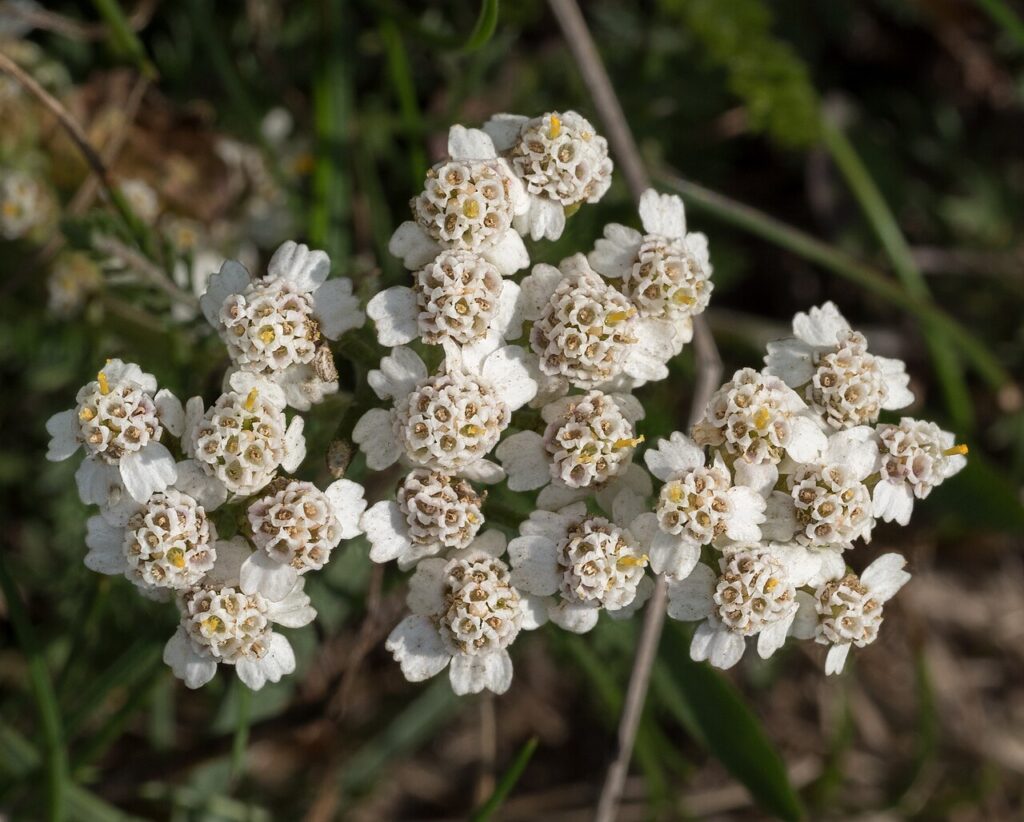
Yarrow (Achillea millefolium) is an aromatic perennial of the daisy family (Asteraceae), instantly recognised by its feathery, finely divided leaves and flat-topped clusters of small white (sometimes pink) flowers (The Wildlife Trusts, n.d.; Royal Horticultural Society, n.d.). It is one of the oldest and most widely used wound herbs in the world, valued across many cultures from Europe to Asia for treating bleeding wounds, inflammation, digestive and gynaecological complaints, and feverish colds (Ali et al., 2017). Its great traditional reputation is as a styptic – the fresh or powdered leaf packed onto a cut to slow bleeding – a use enshrined in country names like “soldier’s woundwort” and “nosebleed plant” (Grieve, 1931; Herbal Reality, n.d.). Internally the aerial parts are taken as a bitter digestive tonic, as a diaphoretic tea to support the body during colds and fevers, and as an antispasmodic for menstrual cramping (Ali et al., 2017; Herbal Reality, n.d.).
Distribution:
Yarrow has a circumboreal distribution, native across the temperate Northern Hemisphere – throughout Europe, western and northern Asia and North America – and naturalised well beyond its native range (Plant Reference, n.d.; Royal Botanic Gardens, Kew, n.d.). It is a plant of open, sunny, often dry ground, growing in meadows, grasslands, pastures, roadside verges, waste places and lawns, and it tolerates poor, low-fertility soils where many plants struggle (First Nature, n.d.; Royal Horticultural Society, n.d.). It spreads both by seed and by shallow rhizomes, forming dense colonies, and is so resilient to mowing and trampling that it persists readily in lawns and grassy paths (North Carolina Extension, n.d.). It is common throughout the Baltic region and across Latvia, a familiar sight on verges, field margins and dry meadows everywhere (First Nature, n.d.).
Notes:
Yarrow is a rhizomatous herbaceous perennial growing to around 30–90 cm tall, with upright, slightly woolly stems and soft, aromatic, fern-like leaves that are bi- to tripinnately divided into thread-like segments – the feature that gives the species its name, millefolium, meaning “a thousand leaves” (Plant Reference, n.d.; United States Forest Service, n.d.). The tiny flower-heads are gathered into dense, flat-topped corymbs, each head bearing a few short white (occasionally pink) ray florets around a cluster of disc florets, and they are much visited by bees, hoverflies and butterflies (First Nature, n.d.; Royal Horticultural Society, n.d.). Chemically yarrow is complex and famously variable, with many recognised chemotypes; its constituents include an essential oil rich in monoterpenes and sesquiterpenes (such as chamazulene, which gives the distilled oil its blue colour, along with sabinene, 1,8-cineole, camphor and α-bisabolol), flavonoids (apigenin, luteolin, rutin, quercetin), sesquiterpene lactones, phenolic acids, tannins, coumarins, the amino-acid derivative betonicine, and the alkaloid-like compound achilleine (Ali et al., 2017). Laboratory studies of these compounds have demonstrated anti-inflammatory, antioxidant, antimicrobial, antispasmodic, antiulcer and wound-healing activities, lending support to many of the plant’s traditional uses (Ali et al., 2017). The aerial parts, harvested in flower, are the main medicinal material, used fresh or dried as poultices, teas, tinctures and styptic powders (Herbal Reality, n.d.).
Identification in the Wild:
Yarrow is one of the most distinctive wayside plants once its two key features are known: the leaves and the flower-heads. The leaves are soft, aromatic and very finely divided into many narrow segments, giving a feathery or fern-like appearance quite unlike most meadow plants (United States Forest Service, n.d.; Royal Horticultural Society, n.d.). The flowers are small and packed into flat-topped clusters (corymbs) held on upright stems, usually white but sometimes pale pink, each tiny head made up of a few rounded ray florets surrounding a denser centre (First Nature, n.d.). Because the flower-heads are flat-topped, yarrow is sometimes mistaken at a glance for a member of the carrot family (Apiaceae), but it is a true member of the daisy family, and crushing a leaf releases a strong, characteristic aromatic, slightly medicinal scent that helps confirm it (First Nature, n.d.). Its close relative sneezewort (Achillea ptarmica) has undivided, toothed leaves and larger, fewer flower-heads and grows in damper ground, so the combination of feathery leaves, flat white flower clusters and aromatic scent reliably identifies common yarrow (First Nature, n.d.). Care should always be taken to distinguish yarrow from superficially similar white-flowered umbellifers, some of which are highly poisonous; the feathery, non-umbellifer leaf and the aromatic scent are the safest distinguishing features (First Nature, n.d.).
When to Collect:
The aerial parts – the upper leafy stems together with the flowers – are gathered when the plant is in full bloom, which across the Baltic and wider European range runs from around June to October, with the plants generally at their best in mid-summer (First Nature, n.d.; United States Forest Service, n.d.). Harvesting in flower captures the plant at the peak of its aromatic essential-oil and flavonoid content. Cut the flowering tops on a dry day once the dew has lifted, and a common practice is to take only the top portion of each plant and leave the lower two-thirds to regrow, allowing a stand to be cut more than once over a long season (Joybilee Farm, n.d.). The fresh tops can be used directly for poultices and tinctures, or tied in small bundles and dried in a single layer in a warm, airy, shaded place; the dried leaves can then be powdered and stored in a jar for use as a styptic first-aid powder (Joybilee Farm, n.d.; Herbal Reality, n.d.). As with all wild harvesting, gather away from roadsides, sprayed verges and other contaminated ground, and be confident of the identification before picking (First Nature, n.d.).
Cultural Notes:
Few plants carry as martial a history as yarrow. Its genus name, Achillea, comes from the Greek hero Achilles, who according to legend was taught by the centaur Chiron to use the herb to staunch the bleeding wounds of his soldiers during the Trojan War (United States Forest Service, n.d.; Grieve, 1931). That battlefield reputation echoes down the centuries in its many country names – soldier’s woundwort, herba militaris, knight’s milfoil, staunchweed and bloodwort – and yarrow was carried in herbal first-aid kits through medieval wars and beyond (Grieve, 1931; Sacred Plant Co, 2025). The name “nosebleed” reflects a curious double tradition: the leaves were used both to stop nosebleeds and, rolled and inserted, deliberately to start one, for instance to relieve a congested headache (Northwest School of Aromatic Medicine, 2026). Beyond wound care, yarrow was long an apothecary’s herb and was even used in the Middle Ages as one of the bittering herbs in gruit, the herb mixture used to flavour ale before hops became common (Royal Horticultural Society, n.d.). It also carries a rich tradition of divination and protection in European and Chinese folk custom, dried yarrow stalks being the classic tool for casting the I Ching (Northwest School of Aromatic Medicine, 2026). In Latvian and broader Baltic folk practice, as across northern Europe, yarrow has long been a standard meadow remedy for wounds, colds and women’s complaints (Herbal Reality, n.d.).
Medicinal Uses and Evidence:
Yarrow’s best-known use is as a styptic and wound healer. Herbalists apply the fresh crushed leaf, or a powder of the dried herb, directly to minor cuts, grazes and shaving nicks to slow bleeding, and use it in poultices, salves and washes to clean and support the healing of wounds, where it is regarded as astringent, anti-inflammatory and antimicrobial (Herbal Reality, n.d.; Joybilee Farm, n.d.). The hemostatic effect is traditionally attributed to its tannins and to the constituent achilleine, although this specific mechanism rests largely on long traditional use rather than robust human trials (Sacred Plant Co, 2025). Internally, yarrow is a classic bitter digestive tonic taken to stimulate appetite and bile flow, a warming diaphoretic tea used at the onset of colds and fevers to support the body’s response, and an antispasmodic used for menstrual cramps and to regulate flow (Ali et al., 2017; Herbal Reality, n.d.). Modern research offers partial support for these uses. The extensive review by Ali and colleagues found that in-vitro and animal studies confirm yarrow’s anti-inflammatory, antioxidant, antimicrobial, antispasmodic, antiulcer and wound-healing activities, providing a rational basis for many of its traditional applications (Ali et al., 2017). An animal study reported that yarrow extract accelerated wound healing in rabbits (Hemmati et al., 2002), and a double-blind randomised controlled trial found that a yarrow tea taken over two menstrual cycles significantly reduced the severity of pain in young women with primary dysmenorrhea compared with placebo (Jenabi and Fereidoony, 2015). Even so, the authors of these reviews stress that well-designed human clinical trials remain limited, so yarrow is best used as a gentle supportive remedy rather than a proven treatment for serious conditions (Ali et al., 2017).
Safety Notes:
Yarrow is generally regarded as safe in culinary amounts and in customary medicinal use, with a very long record of topical use on wounds (Ali et al., 2017). As a member of the daisy family (Asteraceae) it can, however, cause allergic reactions or contact dermatitis in people sensitive to that family (such as those allergic to ragweed, chamomile or chrysanthemums), and handling the fresh plant in sunlight can occasionally cause photosensitivity (Ali et al., 2017). Because yarrow can stimulate the uterus and influence menstruation, its medicinal use is traditionally avoided during pregnancy, and caution is advised while breastfeeding (Herbal Reality, n.d.). It may also interact with anticoagulant, sedative and blood-pressure medications and with drugs metabolised by the liver, so anyone on regular medication should seek professional advice before using it medicinally (Ali et al., 2017). Correct identification is essential, since several poisonous white-flowered umbellifers can be confused with yarrow by the inexperienced, and clinical evidence in humans is still limited, so yarrow should support rather than replace conventional treatment, with deep or infected wounds always warranting proper medical care (First Nature, n.d.; Ali et al., 2017).
References:
Ali, S.I., Gopalakrishnan, B. and Venkatesalu, V. (2017) ‘Pharmacognosy, Phytochemistry and Pharmacological Properties of Achillea millefolium L.: A Review’, Phytotherapy Research, 31(8), pp. 1140–1161. doi:10.1002/ptr.5840.
First Nature (n.d.) ‘Achillea millefolium, Yarrow: identification, distribution, habitat’. Available at: https://www.first-nature.com/flowers/achillea-millefolium.php (Accessed: 7 June 2026).
Grieve, M. (1931) A Modern Herbal. London: Jonathan Cape. Available at: https://botanical.com/botanical/mgmh/y/yarrow03.html (Accessed: 7 June 2026).
Hemmati, A.A., Arzi, A. and Amin, M. (2002) ‘Effect of Achillea millefolium extract in wound healing of rabbit’, Journal of Natural Remedies, 2(2), pp. 164–167.
Herbal Reality (n.d.) ‘Yarrow (Achillea millefolium): Benefits, Uses, Safety’. Available at: https://www.herbalreality.com/herb/yarrow/ (Accessed: 7 June 2026).
Jenabi, E. and Fereidoony, B. (2015) ‘Effect of Achillea millefolium on relief of primary dysmenorrhea: a double-blind randomized clinical trial’, Journal of Pediatric and Adolescent Gynecology, 28(5), pp. 402–404. doi:10.1016/j.jpag.2014.12.008.
Joybilee Farm (n.d.) ‘How to Stop Bleeding with Yarrow Styptic’. Available at: https://joybileefarm.com/how-to-stop-bleeding-yarrow/ (Accessed: 7 June 2026).
North Carolina Extension (n.d.) ‘Achillea millefolium’. North Carolina Extension Gardener Plant Toolbox. Available at: https://plants.ces.ncsu.edu/plants/achillea-millefolium/ (Accessed: 7 June 2026).
Northwest School of Aromatic Medicine (2026) ‘Yarrow in Herbal & Aromatic Medicine: History, Uses, and Energetics’. Available at: https://aromaticmedicineschool.com/yarrow-herbal-medicine-history-uses-energetics/ (Accessed: 7 June 2026).
Plant Reference (n.d.) ‘Achillea millefolium (common yarrow) – Identification & Care Guide’. Available at: https://www.plantref.org/plants/achillea-millefolium (Accessed: 7 June 2026).
Royal Botanic Gardens, Kew (n.d.) ‘Achillea millefolium L.’ Plants of the World Online. Available at: https://powo.science.kew.org/taxon/urn:lsid:ipni.org:names:181164-1 (Accessed: 7 June 2026).
Royal Horticultural Society (n.d.) ‘Achillea millefolium (common yarrow)’. Available at: https://www.rhs.org.uk/plants/311/achillea-millefolium/details (Accessed: 7 June 2026).
Sacred Plant Co (2025) ‘Yarrow: The Warrior’s Wound Healer’. Available at: https://sacredplantco.com/blogs/natures-pharmacy-exploring-the-historical-uses-and-health-benefits-of-medicinal-herbs/the-warrior-s-herb-that-bridged-ancient-legends-and-modern-wound-care (Accessed: 7 June 2026).
The Wildlife Trusts (n.d.) ‘Yarrow’. Available at: https://www.wildlifetrusts.org/wildlife-explorer/wildflowers/yarrow (Accessed: 7 June 2026).
United States Forest Service (n.d.) ‘Common Yarrow (Achillea millefolium)’. Plant of the Week. Available at: https://www.fs.usda.gov/wildflowers/plant-of-the-week/achillea_millefolium.shtml (Accessed: 7 June 2026).
0 Comments
Join the conversation
Log in or create a free account to share your thoughts and vote on comments.
No comments yet — be the first to share your thoughts.