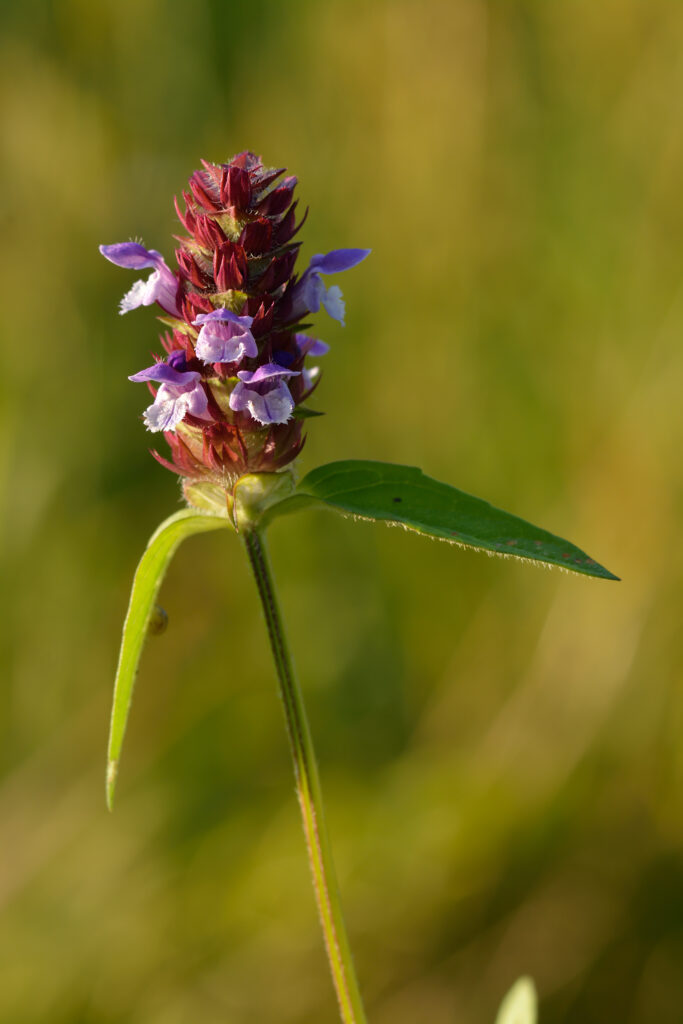
Heal-all (Prunella vulgaris) is one of the most overlooked wild plants in temperate grassland. It grows in lawns, path edges, and damp turf, rarely rising above the grass around it, and its small violet flowers are easily mistaken for several other low, blue-flowered plants. Reliable identification comes down to four features: the family it belongs to, the stem, the leaves, and above all the flower spike.
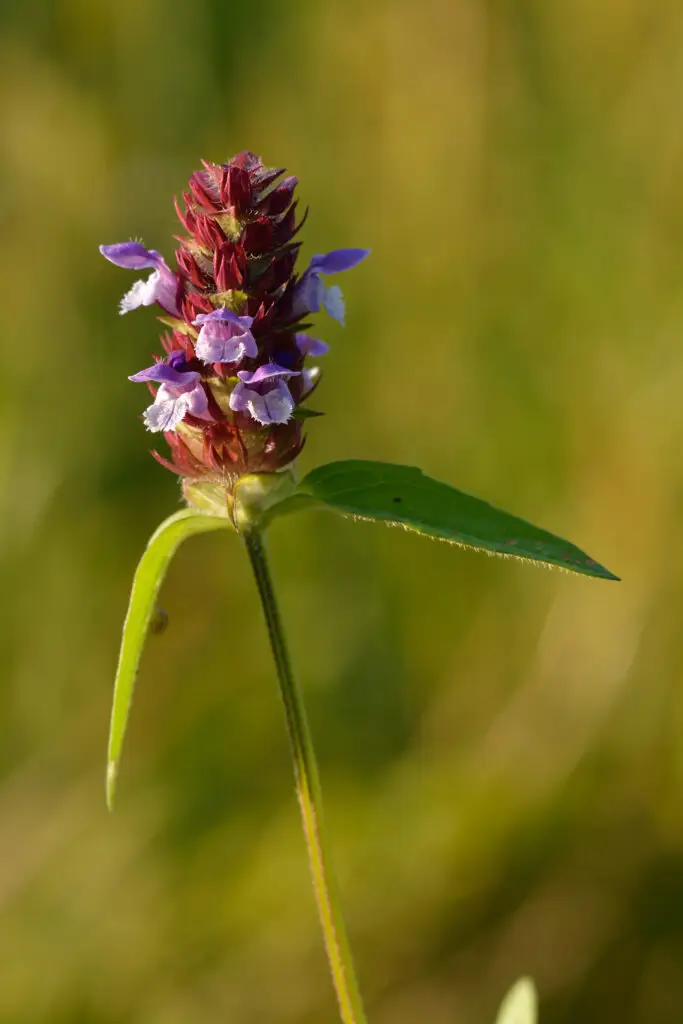
A member of the mint family
Heal-all is a low, creeping perennial in the mint family (Lamiaceae), usually five to thirty centimetres tall. Like its relatives it has a square stem, leaves in opposite pairs, and small two-lipped flowers. Confirming those three traits is the first step in separating it from unrelated look-alikes that merely share its colour or habit. It is native across Europe, Asia, and North America and naturalised well beyond.
Square stem and paired leaves
Roll the stem between finger and thumb: it has four distinct edges rather than a round cross-section, ruling out grasses and plantains at once. The stem is often tinged red, branches at the leaf axils, and frequently lies along the ground before turning up at the tip. The leaves grow in opposite pairs, each pair set at right angles to the last. They are lance-shaped to oval, one and a half to six centimetres long, shortly stalked, with smooth or shallowly toothed margins and a faint scent when crushed.
The flower spike: the decisive feature
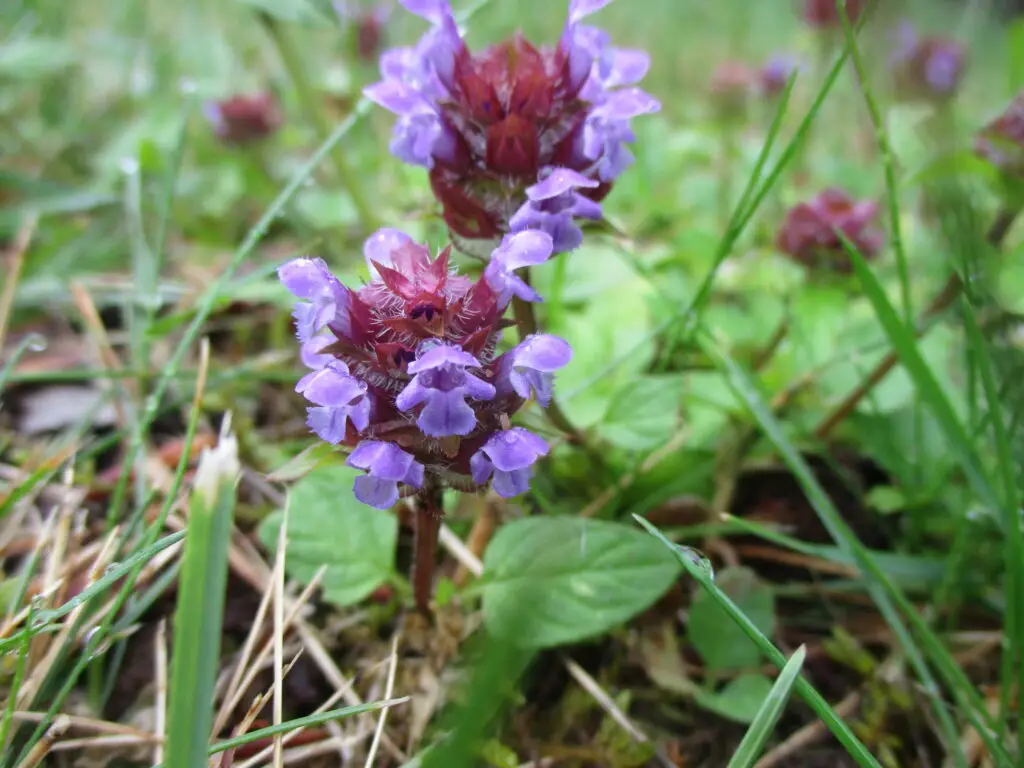
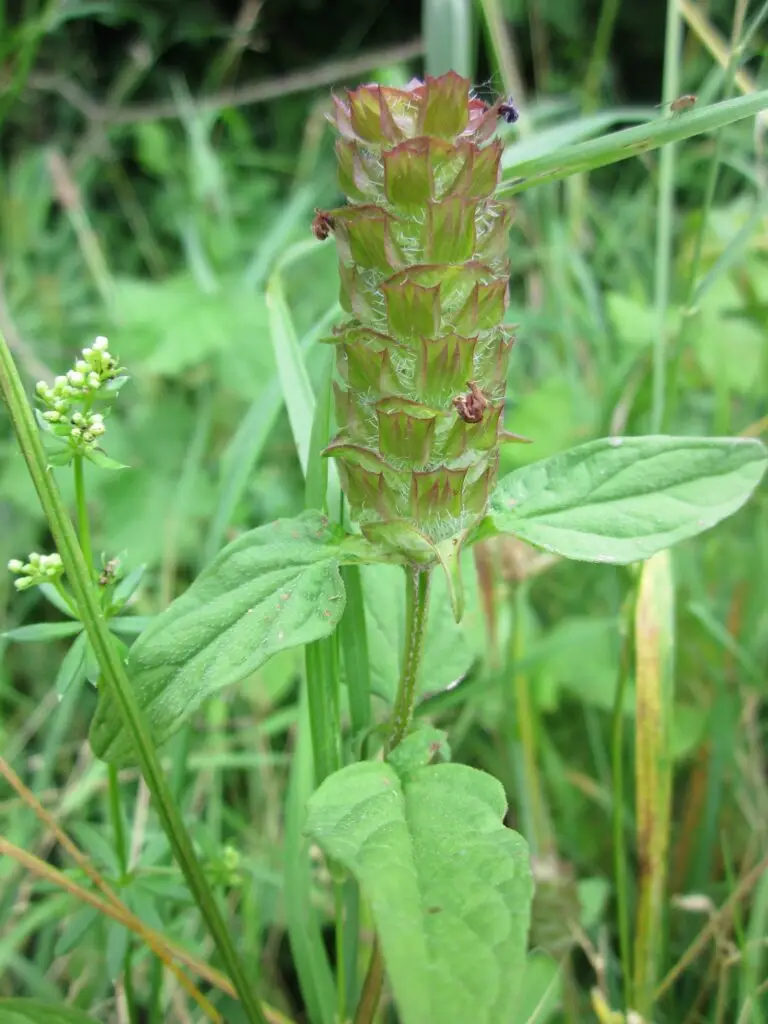
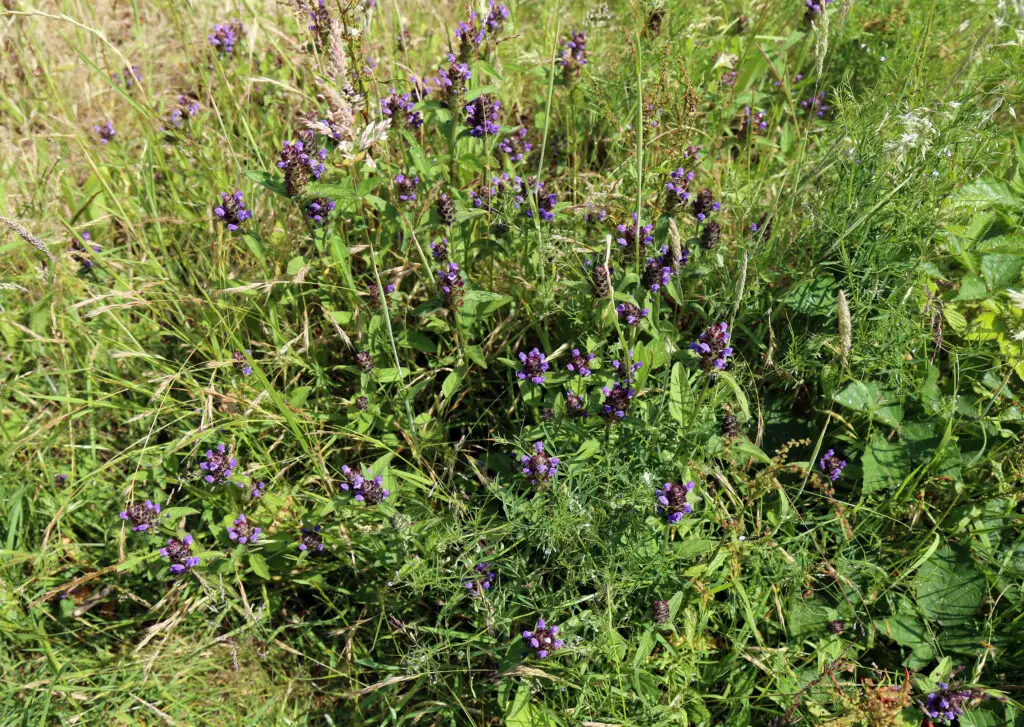
The flower head makes heal-all unmistakable. The flowers are packed into a dense, squarish spike two to five centimetres long at the top of the stem, shaped almost like a small club, with a pair of broad, often purple-tinged bracts beneath each whorl. Individual flowers are violet to blue-purple, occasionally pink or white, and two-lipped: a hooded upper lip shelters the reproductive parts, while the lobed lower lip serves as a landing platform for bees. Usually only a few flowers open at once, and the dried spike persists into autumn, so the plant stays identifiable out of season.
Where and when to look
Heal-all favours moist, disturbed, regularly cut ground: lawns, verges, woodland rides, and trodden path margins, in sun or light shade. It avoids very dry or strongly calcareous soils, and is often most abundant where mowing removes its taller competitors. In the northern hemisphere it flowers mainly from June to September, with a mid-summer peak.
Plants it is confused with
The commonest confusion is with bugle (Ajuga reptans): taller and more upright, with a looser, leafier spike and no hooded upper lip. Ground-ivy (Glechoma hederacea) has rounded, scalloped leaves and flowers clustered in the leaf axils rather than in a terminal spike. The blue-flowered speedwells have flat, four-petalled flowers and round stems, placing them in another family entirely.
A reliable rule is to require three things together before naming a plant as heal-all: a square stem, opposite untoothed or shallowly toothed leaves, and a short, dense terminal spike with paired bracts beneath each whorl. When all three are present, no common look-alike fits. As with any wild plant, never identify from a single feature, and never consume a plant you cannot name with certainty.
References
Botanical Society of Britain and Ireland (n.d.) ‘Prunella vulgaris’. Available at: https://bsbi.org/ (Accessed: 27 June 2026).
Go Botany, Native Plant Trust (n.d.) ‘Prunella vulgaris (common selfheal, heal-all)’. Available at: https://gobotany.nativeplanttrust.org/species/prunella/vulgaris/ (Accessed: 27 June 2026).
Minnesota Wildflowers (n.d.) ‘Prunella vulgaris (Self-heal)’. Available at: https://www.minnesotawildflowers.info/flower/self-heal (Accessed: 27 June 2026).
Royal Botanic Gardens, Kew (n.d.) ‘Prunella vulgaris L.’ Plants of the World Online. Available at: https://powo.science.kew.org/ (Accessed: 27 June 2026).
Wikipedia (n.d.) ‘Prunella vulgaris’. Available at: https://en.wikipedia.org/wiki/Prunella_vulgaris (Accessed: 27 June 2026).
0 Comments
Join the conversation
Log in or create a free account to share your thoughts and vote on comments.
No comments yet — be the first to share your thoughts.