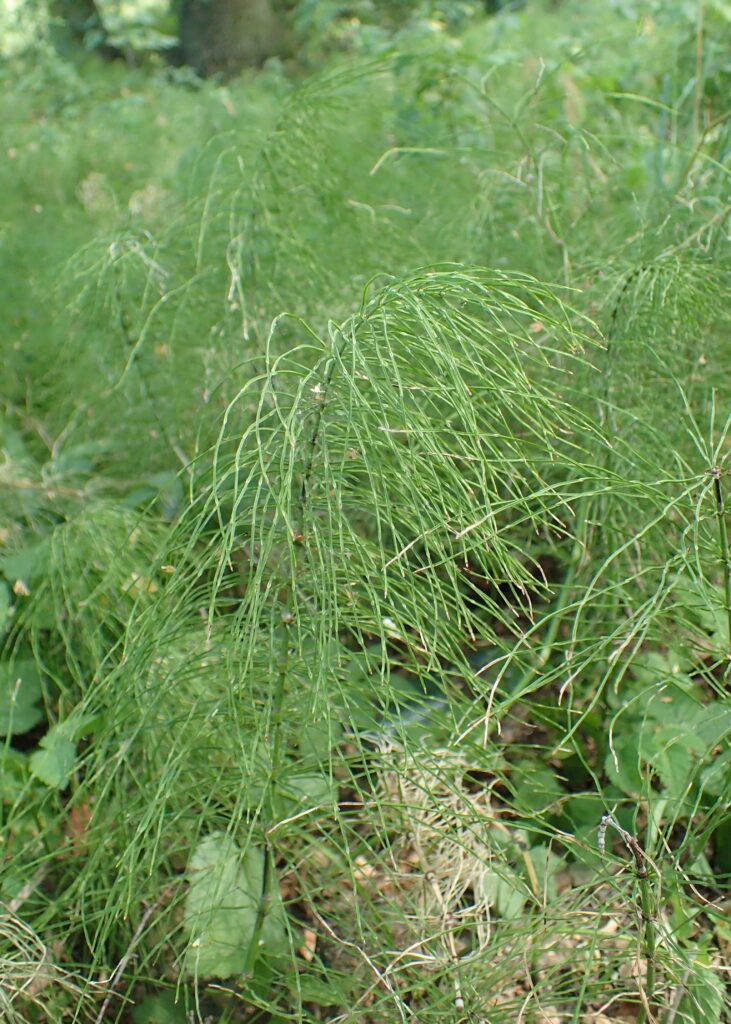
Quick ID Profile
- Latin name
- Equisetum pratense
- Common names
- Shady horsetail, meadow horsetail
- Family
- Equisetaceae (horsetail family)
- Key visual ID
- Whorls of fine, simple (unbranched), triangular-section side branches on a rough central stem; sheaths with 8-10 fine dark, white-margined, well-separated teeth
- Habitat
- Damp, shaded ground – woodland, streamsides and shaded banks
- Height
- Up to about 50 cm
- Look-alikes
- Wood horsetail (branches themselves branched and drooping); field horsetail (thicker, cross-shaped branches)
Shady horsetail (Equisetum pratense), also called meadow horsetail, is a delicate, spore-bearing plant of damp, shaded ground. Horsetails are not flowering plants but ancient relatives of ferns, and they are notoriously difficult to tell apart. Reliable identification of this species rests on the slender, mostly unbranched side branches, the cross-sectional shape of those branches, and the fine, well-separated teeth on the stem sheaths.
Overall form
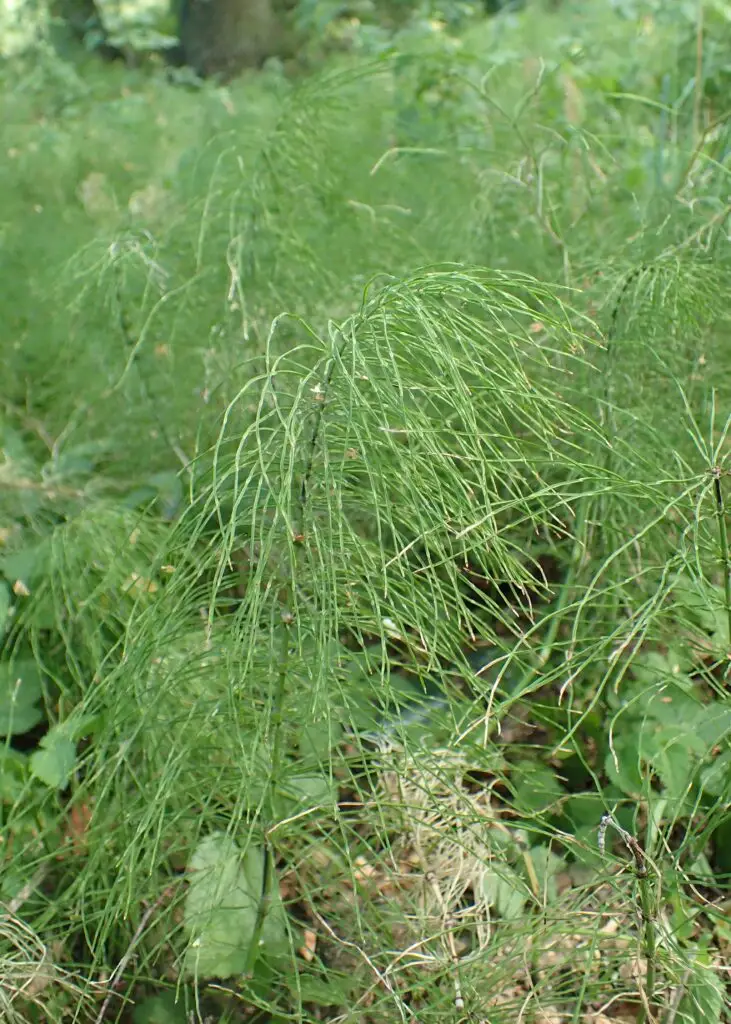
Shady horsetail is a small to medium plant, reaching about fifty centimetres. From an upright central stem rise many whorls of fine, thread-like branches, giving the plant a soft, almost feathery look. The branches are usually simple and unbranched, and the topmost ones are often swept to one side, lending the plant a slightly lopsided, delicate appearance. The central stem itself is rough to the touch.
Branches and sheaths
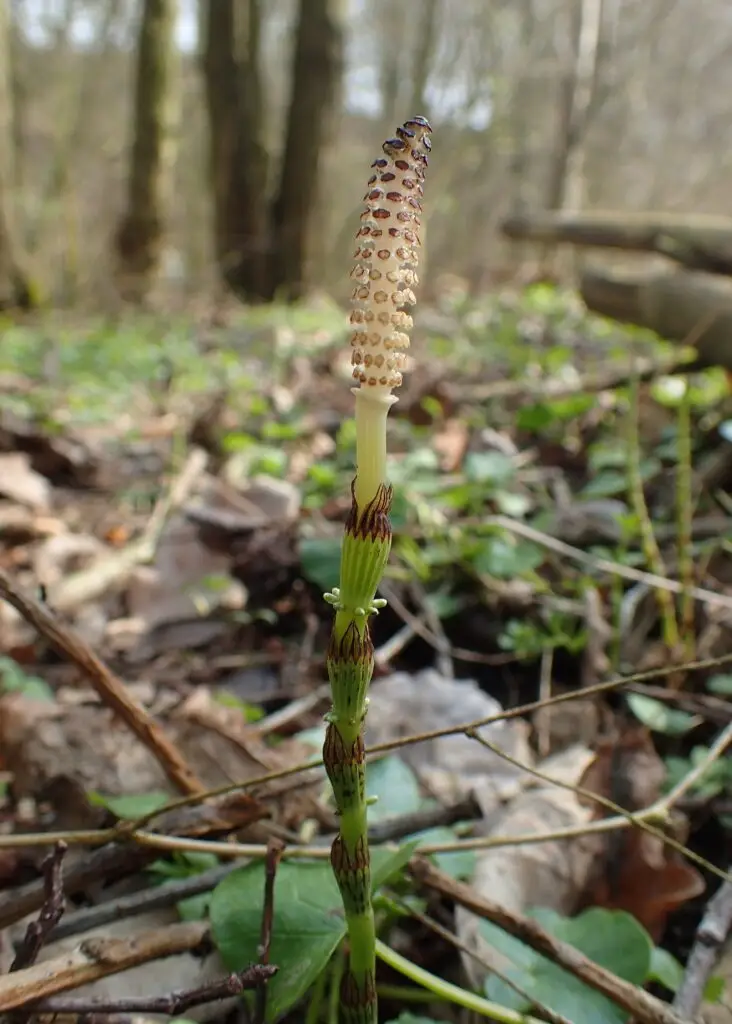
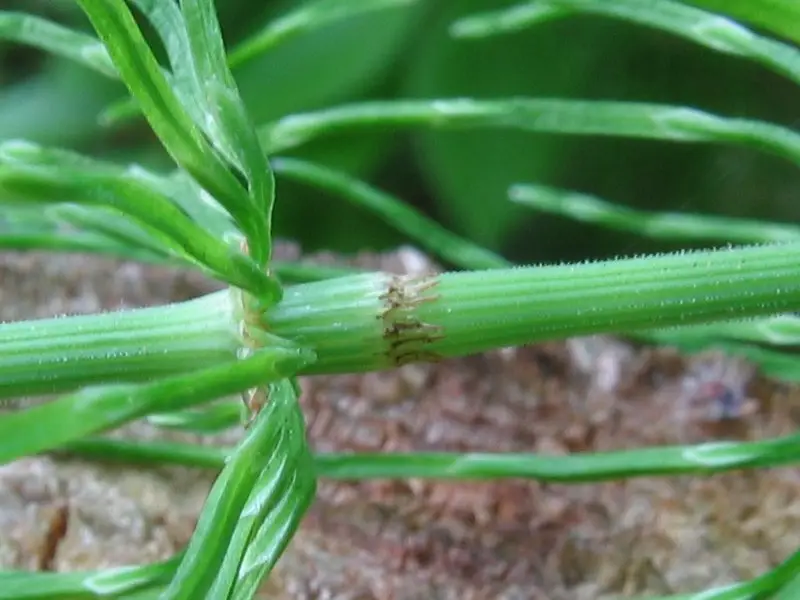
Two details confirm the identification under a hand lens. First, the side branches are triangular in cross-section and, importantly, are themselves unbranched. Second, the sheaths that ring each node of the main stem bear fine teeth that are dark with pale, papery margins, straight, and clearly separated from one another, usually eight to ten of them. The first segment of each branch is shorter than the stem sheath beside it, a further point used to separate it from field horsetail.
Distinguishing it from similar horsetails
The most important comparison is with wood horsetail (Equisetum sylvaticum), whose branches are themselves branched and arch downward, and whose stem-sheath teeth are broader, paler, and fused into a few chaffy lobes. Field horsetail (Equisetum arvense), the common garden weed, has thicker branches that are roughly cross-shaped rather than triangular in section. Shady horsetail, by contrast, keeps its branches simple, slender, and triangular.
Habitat and a reliable rule
As its names suggest, this is a plant of cool, moist, shaded places: damp woodland, streamsides, and shaded grassy banks. To name it, look for a delicate horsetail with simple, triangular, unbranched side branches, fine well-spaced sheath teeth, and a rough central stem, growing in shade. Branches that are themselves branched indicate wood horsetail instead. As with any wild plant, confirm more than one feature before drawing a conclusion.
Shady horsetail vs wood horsetail
| Feature | Shady horsetail (E. pratense) | Wood horsetail (E. sylvaticum) |
|---|---|---|
| Branch pattern | Simple, unbranched | Branches themselves branched (twice-divided) |
| Branch posture | Straight, spreading; delicate | Arching and drooping; lacy, fountain-like |
| Branch cross-section | Triangular | Fine and compound |
| Sheath teeth | 8-10 fine, dark, white-margined, clearly separated | Broad, reddish-brown, fused into 3-4 papery lobes |
| Typical height | Up to about 50 cm | About 30-50 cm |
| Habitat | Damp, shaded ground; woodland and streamsides | Damp shade; moist woodland and acidic grassland |
References
Botanical Society of Britain and Ireland (n.d.) ‘Equisetum pratense Ehrh., Shady Horsetail’. Available at: https://bsbi.org/learn/resources/species-accounts/equisetum-pratense (Accessed: 27 June 2026).
Minnesota Wildflowers (n.d.) ‘Equisetum pratense (Meadow Horsetail)’. Available at: https://www.minnesotawildflowers.info/fern/meadow-horsetail (Accessed: 27 June 2026).
Go Botany, Native Plant Trust (n.d.) ‘Equisetum pratense (meadow horsetail)’. Available at: https://gobotany.nativeplanttrust.org/species/equisetum/pratense/ (Accessed: 27 June 2026).
Wikipedia (n.d.) ‘Equisetum pratense’. Available at: https://en.wikipedia.org/wiki/Equisetum_pratense (Accessed: 27 June 2026).
0 Comments
Join the conversation
Log in or create a free account to share your thoughts and vote on comments.
No comments yet — be the first to share your thoughts.