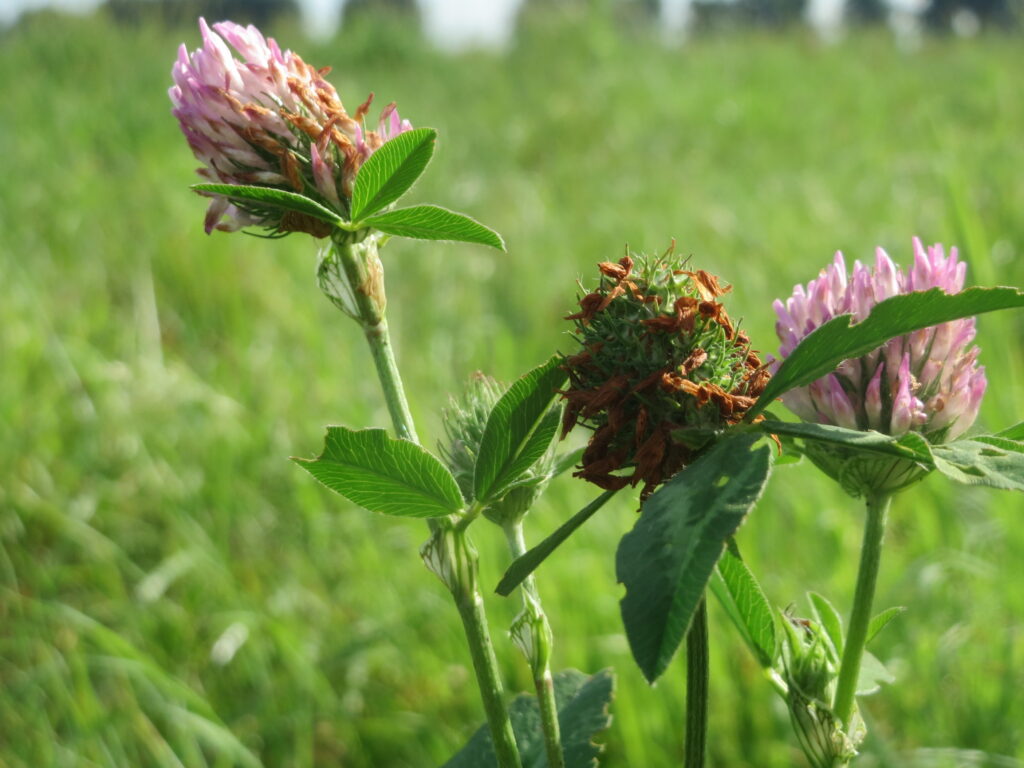
Quick ID Profile
- Latin name
- Trifolium pratense
- Common names
- Red clover
- Family
- Fabaceae (pea family)
- Key visual ID
- Upright, hairy branching stems; trifoliate leaves with a pale V-shaped chevron; dense pink-purple flower heads set close above a pair of leaves
- Habitat
- Meadows, verges and rough grassland
- Height
- About 20-60 cm, upright
- Look-alikes
- White clover (creeping, hairless, white heads on long stalks)
Red clover (Trifolium pratense) is one of the most familiar plants of meadows, verges, and rough grassland, widely grown as a fodder crop and equally common as a wildflower. It is straightforward to identify once a few features are clear: the trifoliate leaves with their pale crescent mark, the dense rounded flower heads, and the upright, hairy habit that separates it from the creeping white clover.
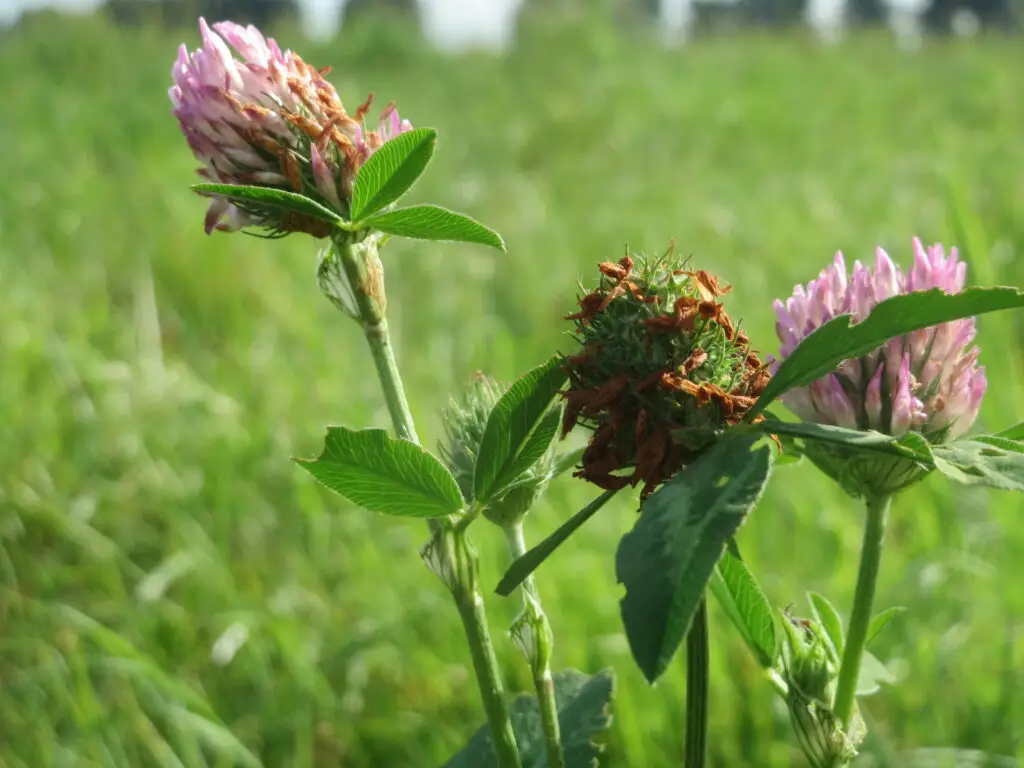
Habit and stems
Red clover is a short-lived perennial growing roughly twenty to sixty centimetres tall. Unlike white clover it does not creep along the ground on rooting runners but forms upright to ascending, branching stems that are noticeably hairy. This more robust, upright habit is one of the quickest ways to distinguish the two clovers at a glance.
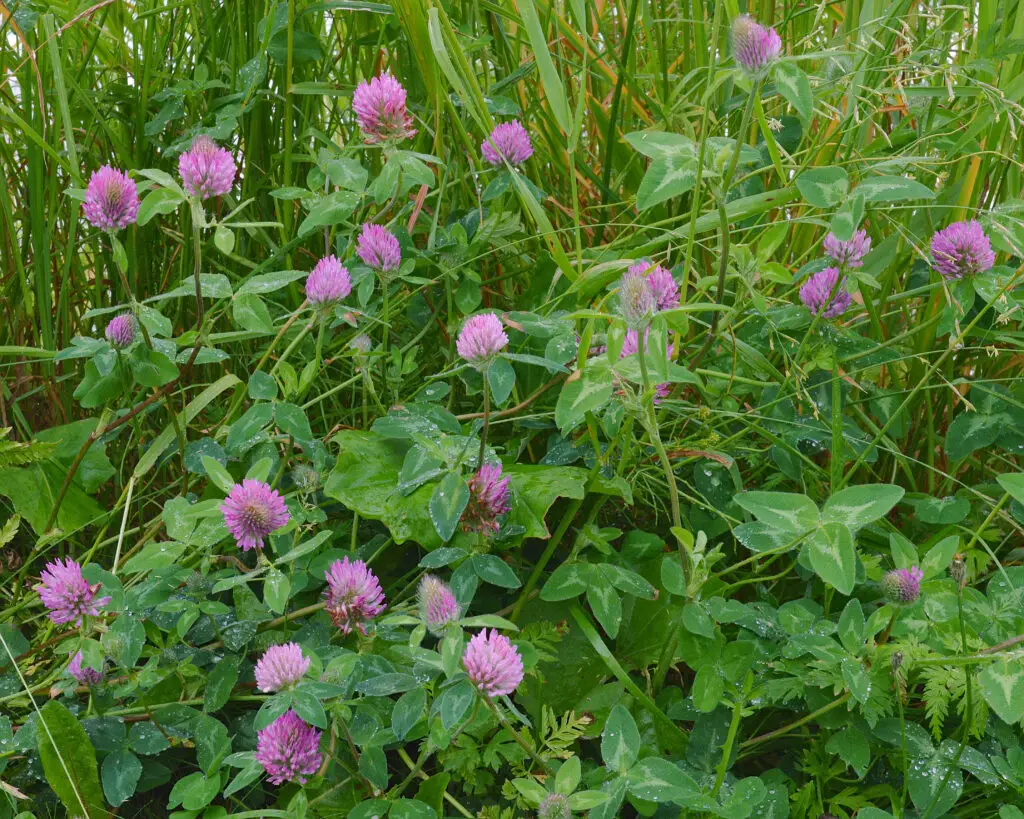
Leaves and the crescent mark
The leaves are trifoliate, each divided into three oval to elliptical leaflets that are finely hairy and only faintly toothed or untoothed. Most leaflets carry a pale, whitish chevron or crescent toward the centre of the upper surface. In red clover this mark tends to be a distinct V or chevron, a useful point of comparison with white clover, whose leaflets usually show a more rounded, band-like watermark.
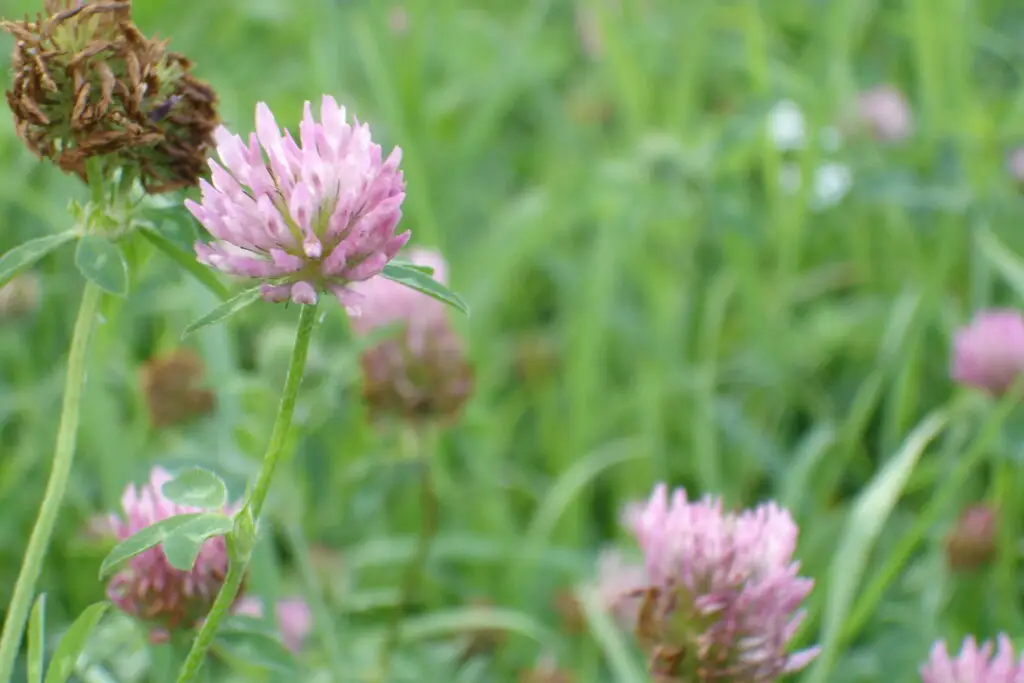
Flower heads
The flowers are carried in dense, rounded heads roughly two to three centimetres across, made up of many small tubular pea-flowers in shades of pink to reddish-purple. A key detail is that the flower head usually sits directly above a pair of leaves with little or no stalk of its own, rather than on a long bare stem. This sessile head, combined with the reddish colour, separates red clover from white clover, whose white heads are raised on long, leafless stalks.
A reliable rule
To name a plant as red clover, look for the combination of upright hairy stems, trifoliate leaves with a pale chevron, and dense pinkish-purple flower heads set close above a pair of leaves. White or long-stalked flower heads, or creeping rooting stems, point instead to white clover. As always, confirm more than one feature, and never consume a plant you cannot identify with certainty.
White clover vs red clover
| Feature | White clover (T. repens) | Red clover (T. pratense) |
|---|---|---|
| Growth habit | Creeping; roots at the nodes, mat-forming | Upright to ascending, branching |
| Stems | Hairless | Noticeably hairy |
| Leaf watermark | Pale, rounded, band-like | Pale, distinct V-shaped chevron |
| Flower colour | White, ageing pink-brown | Pink to reddish-purple |
| Flower head | On a long, leafless stalk | Stalkless, above a pair of leaves |
| Typical height | Creeping; flower stalks to about 15 cm | About 20-60 cm |
| Habitat | Lawns, pastures and verges | Meadows, verges and rough grassland |
References
First Nature (n.d.) ‘Trifolium pratense – Red Clover’. Available at: https://www.first-nature.com/flowers/trifolium-pratense.php (Accessed: 27 June 2026).
Go Botany, Native Plant Trust (n.d.) ‘Trifolium pratense (red clover)’. Available at: https://gobotany.nativeplanttrust.org/species/trifolium/pratense/ (Accessed: 27 June 2026).
Minnesota Wildflowers (n.d.) ‘Trifolium pratense (Red Clover)’. Available at: https://www.minnesotawildflowers.info/flower/red-clover (Accessed: 27 June 2026).
Wikipedia (n.d.) ‘Trifolium pratense’. Available at: https://en.wikipedia.org/wiki/Trifolium_pratense (Accessed: 27 June 2026).
0 Comments
Join the conversation
Log in or create a free account to share your thoughts and vote on comments.
No comments yet — be the first to share your thoughts.