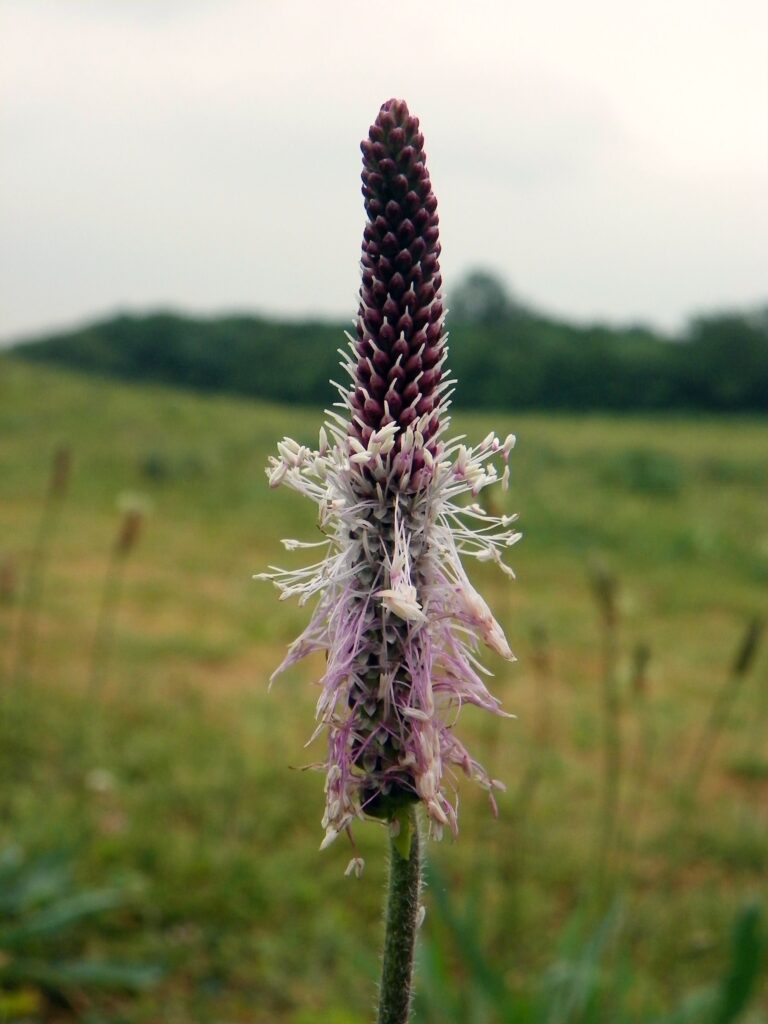
Broadleaf plantain (Plantago major) and hoary plantain (Plantago media) are two common rosette-forming plants of lawns, verges, and grassland. They share the same basic plan and are often confused, but a few features separate them reliably: leaf shape and hairiness, the length of the leaf stalk, and the appearance of the flower spike.
The shared plantain pattern
Both species grow as a flat basal rosette of leaves from which rise leafless flowering stalks, each ending in a dense, narrow spike of many tiny flowers. The leaves of both have prominent, roughly parallel ribs running from base to tip, a feature that distinguishes plantains from most other rosette plants. The differences lie in the detail of the leaves and the flower spikes.
Broadleaf plantain (Plantago major)
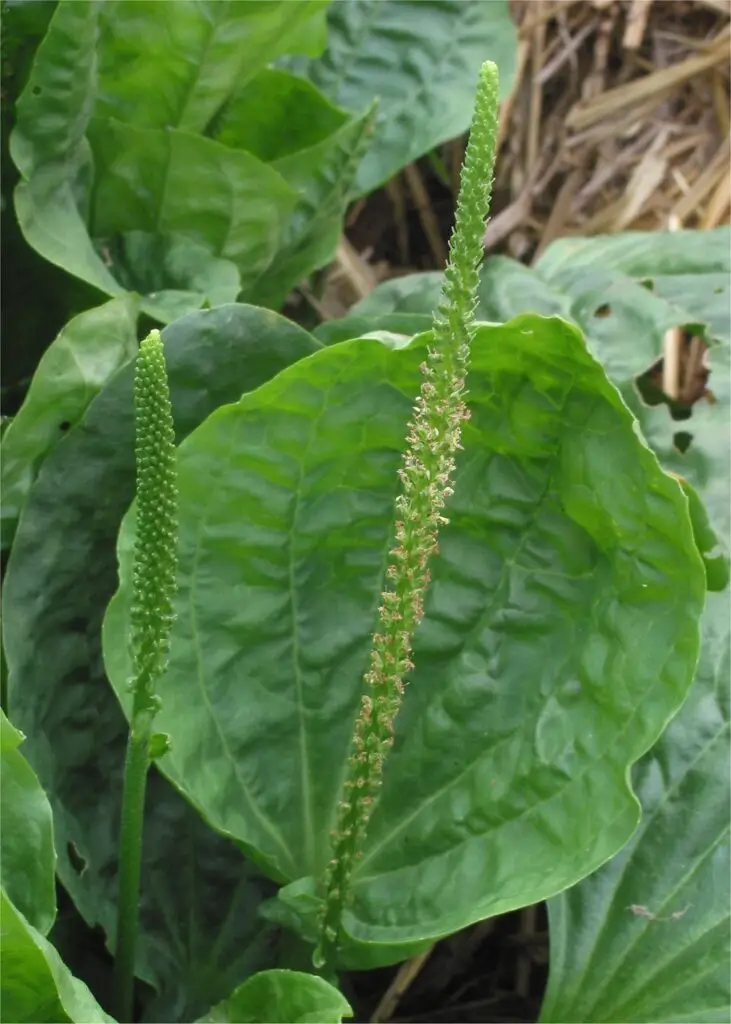
Broadleaf plantain has broad, oval to egg-shaped leaves, five to twenty centimetres long, with a smooth or slightly toothed margin and an essentially hairless, often glossy surface. Each leaf narrows into a distinct stalk almost as long as the blade itself. The flower spike is long and slender, often half the height of the stalk or more, and greenish-brown with small purplish stamens. It favours trodden, compacted ground and is one of the most reliable indicators of footpaths and gateways.
Hoary plantain (Plantago media)
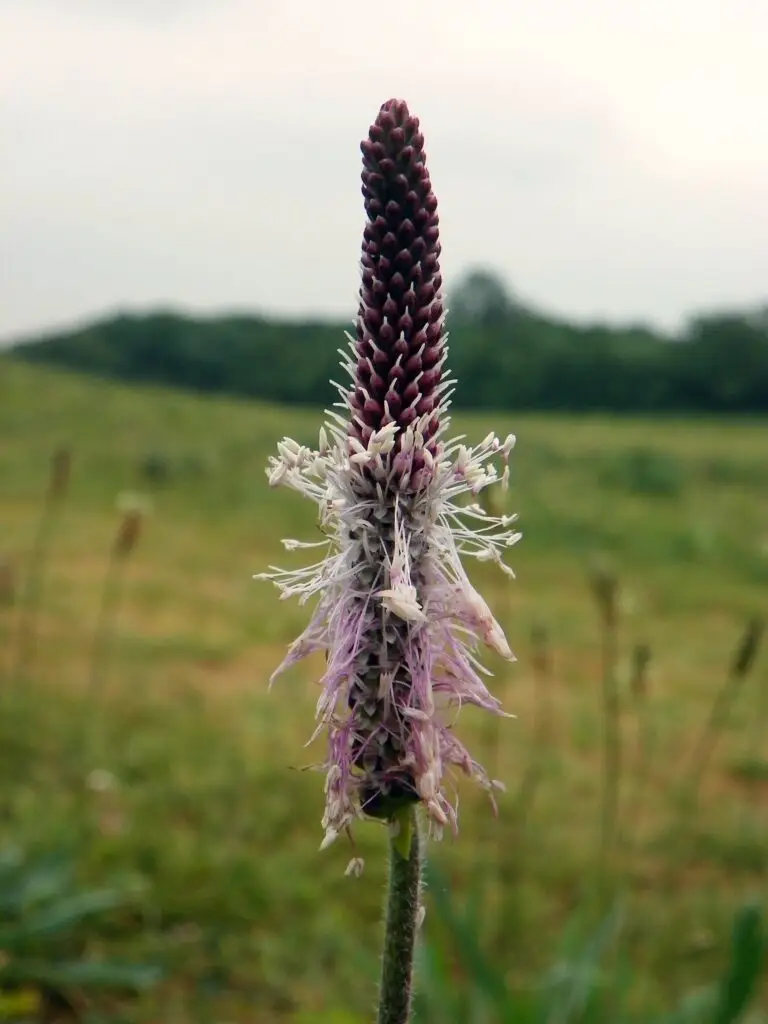
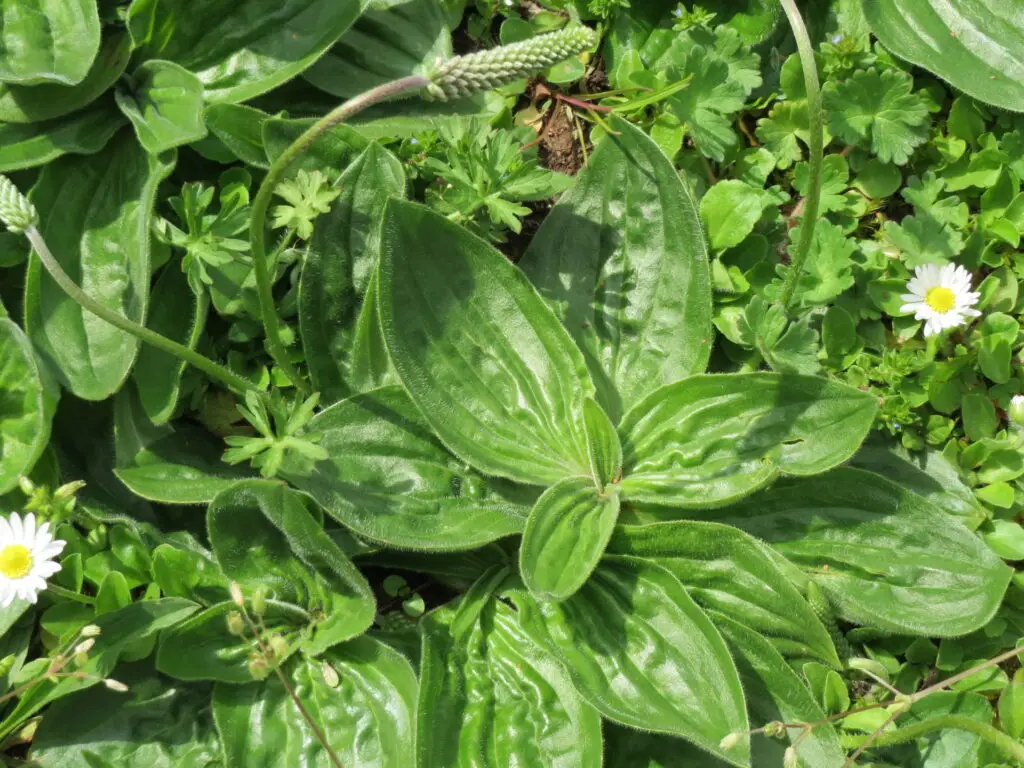
Hoary plantain is the softer, greyer plant of the two. Its leaves are elliptical, greyish-green, and covered in fine hairs that give the rosette a downy, hoary appearance, hence the name. They lie flatter against the ground and taper into a very short stalk rather than the long petiole of broadleaf plantain. The flower spike is shorter and denser, and at flowering it is ringed with conspicuous pink to lilac stamens that make it far showier, and faintly fragrant, than the dull spike of broadleaf plantain. Hoary plantain prefers dry, lime-rich grassland rather than compacted paths.
Telling the two apart
Three features settle the question. First, hairiness: hoary plantain is softly hairy and grey-green, broadleaf plantain is largely hairless and bright green. Second, the leaf stalk: long and well defined in broadleaf plantain, very short in hoary plantain. Third, the flowering spike: dull and greenish-brown in broadleaf plantain, but conspicuously ringed with pink-lilac stamens in hoary plantain. Habitat adds a further clue, with broadleaf plantain on trodden ground and hoary plantain in dry calcareous grassland.
As with any wild plant, confirm more than one feature before naming it, and never consume a plant you cannot identify with certainty.
References
Cornell CALS (n.d.) ‘Plantains’. Weed Profiles. Available at: https://cals.cornell.edu/weed-science/weed-profiles/plantains (Accessed: 27 June 2026).
Stojković, D. et al. (2021) ‘Plantago media L.—Explored and Potential Applications of an Underutilized Plant’, Plants, 10(2), 256. Available at: https://www.ncbi.nlm.nih.gov/pmc/articles/PMC7912141/ (Accessed: 27 June 2026).
Wikipedia (n.d.) ‘Plantago major’. Available at: https://en.wikipedia.org/wiki/Plantago_major (Accessed: 27 June 2026).
Photographing Wildflowers (n.d.) ‘Plantains – Plantago species’. Available at: https://photographingwildflowers.co.uk/wildflowers/plantains-plantago-species/ (Accessed: 27 June 2026).
0 Comments
Join the conversation
Log in or create a free account to share your thoughts and vote on comments.
No comments yet — be the first to share your thoughts.