Common Names: Broadleaf plantain, greater plantain, common plantain, waybread, white man’s footprint, soldier’s herb, healing blade, cuckoo’s bread, rat’s tail
Genus: Plantago
Parts Used: Leaf, Aerial parts, Seed
Medicinal Actions: Vulnerary (wound healing), Anti-inflammatory, Astringent, Demulcent, Expectorant, Antimicrobial, Antioxidant
Preparation Methods: Poultice, Cooked, Tea/Infusion, Tincture, Salve
Summary:
Broadleaf plantain (Plantago major) is a low-growing perennial of the Plantaginaceae family that grows as a flat rosette of broad, ribbed leaves on lawns, paths and waste ground throughout the world (The Wildlife Trusts, n.d.; Royal Horticultural Society, n.d.). Despite being dismissed today as a common lawn weed, its leaves have been used as a wound-healing remedy for centuries in almost every part of the world, alongside uses for ailments of the skin, respiratory organs, digestive organs, the circulation and against infection and pain (Samuelsen, 2000). The fresh leaf, crushed or chewed into a “spit poultice”, is a classic field first-aid dressing for cuts, stings and insect bites, while infusions of the leaf have a long history as a soothing remedy for coughs and irritated tissues (Herbal Reality, n.d.; Grieve, 1931). It is also an edible, highly nutritious wild green, rich in calcium and vitamins A, C and K (North Carolina Extension, n.d.).
Distribution:
Native to most of Europe and to northern and central Asia, broadleaf plantain has been carried by people across the globe and is now naturalised on every continent except Antarctica (Royal Botanic Gardens, Kew, n.d.; Samuelsen, 2000). It thrives in compacted, disturbed and trampled ground – lawns, pavements, cart tracks, field edges, roadsides and waste places – and tolerates a very wide range of soils, including heavy and compacted ones (Royal Horticultural Society, n.d.; The Wildlife Trusts, n.d.). Because it follows human activity so faithfully it is abundant across the Baltic region and throughout Latvia wherever the ground has been disturbed, from garden paths and farmyards to roadside verges (The Wildlife Trusts, n.d.).
Notes:
Broadleaf plantain is a herbaceous perennial forming a basal rosette of leaves 15–30 cm across, from which slender, leafless flower spikes rise to around 13–15 cm, occasionally taller (Royal Horticultural Society, n.d.; The Wildlife Trusts, n.d.). The small, greenish-brown wind-pollinated flowers are packed into a dense narrow spike, and a single plant can produce many thousands of tiny seeds in a growing season (North Carolina Extension, n.d.). Chemically the plant is unusually well studied: it contains biologically active polysaccharides, lipids, caffeic acid derivatives, flavonoids, iridoid glycosides and terpenoids, along with alkaloids and organic acids (Samuelsen, 2000). Among the most important constituents are the iridoid glycoside aucubin and its relative catalpol, the caffeic acid esters plantamajoside and acteoside (verbascoside), the flavonoids baicalein, luteolin and hispidulin, the cell-proliferative compound allantoin, mucilage and the triterpenes ursolic and oleanolic acid (Adom et al., 2017; Samuelsen, 2000). These compounds underpin a range of activities demonstrated in laboratory studies, including wound healing, anti-inflammatory, analgesic, antioxidant, weak antibiotic, immunomodulating and antiulcerogenic effects (Samuelsen, 2000). Traditionally the leaf is the main medicinal part – applied fresh as a poultice or salve to wounds, stings and inflamed skin, taken as a tea or tincture for coughs, catarrh and diarrhoea, and the mucilaginous seeds used as a gentle bulk laxative (Herbal Reality, n.d.; Grieve, 1931).
Identification in the Wild:
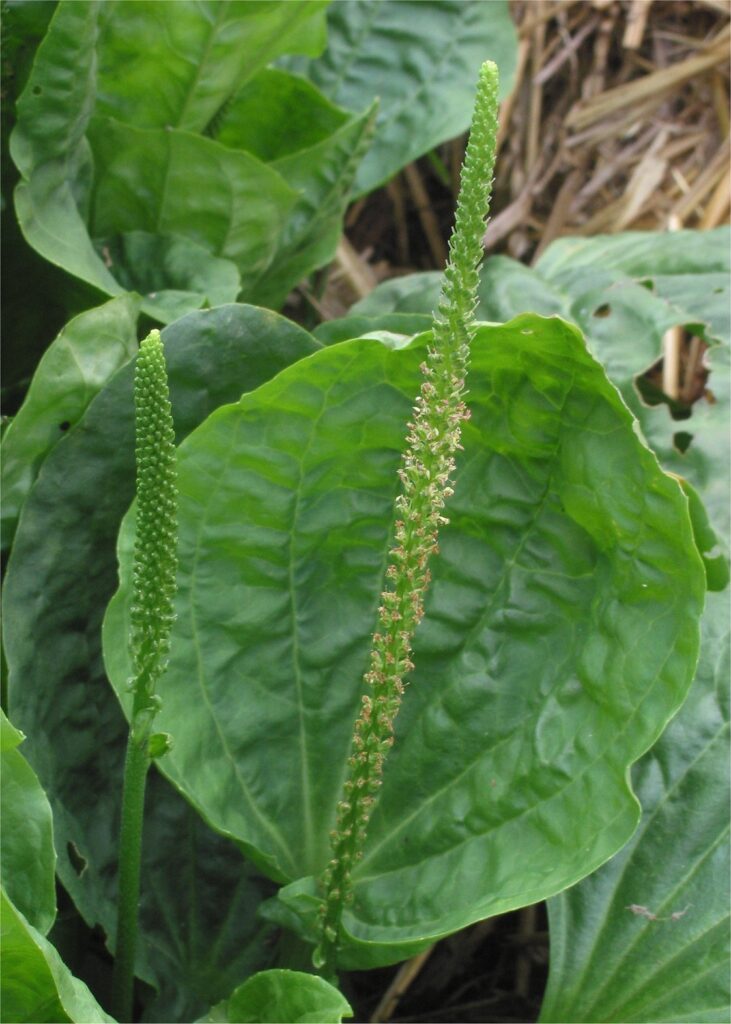
Broadleaf plantain is one of the easier wild plants to recognise once its key features are known. It grows as a flat rosette pressed close to the ground, with broad, oval to egg-shaped leaves 5–20 cm long carried on distinct stalks (petioles) almost as long as the leaf blade itself (Royal Botanic Gardens, Kew, n.d.; North Carolina Extension, n.d.). The clearest single feature is the venation: five to nine prominent, parallel veins run the length of each leaf, and if a leaf is gently pulled apart these veins separate out as tough, elastic, string-like fibres – a quick field test that distinguishes plantain from look-alikes (Edible Wild Food, n.d.; The Herbal Medic, n.d.). From the centre of the rosette rise slender, leafless stalks topped with a dense, narrow spike of tiny greenish-brown flowers, often likened to a rat’s tail, which give the plant its country name (The Wildlife Trusts, n.d.). Its close relative ribwort plantain (Plantago lanceolata) has much narrower, lance-shaped leaves and a short, dark, almost cone-like flower head, but the two share the same parallel-veined leaves and are used interchangeably in herbal practice (The Herbal Medic, n.d.; Herbal Reality, n.d.). The leaves are tough and resilient to trampling, and broadleaf plantain’s habit of carpeting paths and lawns, combined with the stringy leaf veins and rat’s-tail flower spike, makes confident identification straightforward (The Wildlife Trusts, n.d.).
When to Collect:
The leaves are the main part to gather and can be collected throughout the growing season, which across the Baltic and wider European range runs from roughly spring through to autumn; the plant flowers from around June to October and the leaves can persist into winter in milder spells (The Wildlife Trusts, n.d.; North Carolina Extension, n.d.). For poultices and other topical first aid the fresh leaf is preferred, picked as needed, since the watery mucilage that makes the crushed leaf cling to the skin is at its best when fresh (Herbal Reality, n.d.). Young leaves gathered in spring and early summer are the most tender for eating as a pot-herb, becoming tougher and more fibrous as the season advances (North Carolina Extension, n.d.). Choose clean, green, undamaged leaves away from roadsides, sprayed lawns and other sources of contamination, and gather on a dry day once the dew has lifted (The Herbal Medic, n.d.). Leaves for teas, tinctures and dried storage are best dried quickly in a single layer in the shade, as research has shown that the active polyphenol and iridoid content is significantly better preserved by gentle, low-temperature drying than by drying at higher temperatures (Zubair, 2012). The seeds can be stripped from the spikes in late summer and autumn once they have ripened and turned brown (North Carolina Extension, n.d.).
Cultural Notes:
Few weeds carry as much history as broadleaf plantain. The genus name Plantago derives from the Latin planta, meaning the sole of the foot, a reference both to the broad flat leaves and to the plant’s habit of springing up along trodden paths (A Wandering Botanist, 2013). In Anglo-Saxon England it was known as waybread and revered as one of the nine sacred herbs of the tenth-century Lacnunga manuscript, named in the Old English Nine Herbs Charm as a protector against poison and infection (Nine Herbs Charm, n.d.). It was valued by classical and medieval physicians from Dioscorides onward, and the seventeenth-century English herbalist Nicholas Culpeper held it in high regard (Grieve, 1931; Living Plant Wisdom, n.d.). When Europeans crossed the Atlantic the plant travelled with them in the mud of their boots and the seed of their livestock, springing up around every new settlement, so that several Native American peoples called it “white man’s footprint” (Royal Botanic Gardens, Kew, n.d.; North Carolina Extension, n.d.). Its tough, trample-resistant leaves and deep roots also make it valuable for stabilising and rehabilitating compacted, eroded soils (North Carolina Extension, n.d.). In Latvian and broader Baltic folk practice, as across northern Europe, the fresh leaf has long been the household remedy reached for first when skin is cut, grazed, stung or bitten (Herbal Reality, n.d.).
Medicinal Uses and Evidence:
Broadleaf plantain’s great reputation is as a tissue healer. Herbalists describe the fresh, mashed or chewed leaf as a “green bandage” or “green sticking plaster” applied to insect bites, stings, minor wounds, grazes, sunburn, rashes and splinters, where its cooling, demulcent and mildly astringent nature soothes inflammation and its “drawing” action is said to help lift out stingers, splinters and venom (Florida School of Holistic Living, n.d.; Herbal Reality, n.d.). A practical field method is the “spit poultice”: a leaf is chewed so that saliva mixes with the leaf mucilage to form a sticky gel that adheres to the skin like a dressing (Herbal Reality, n.d.). Internally, the tannin content makes a strong leaf tea a traditional remedy for diarrhoea, while the leaf’s soothing, expectorant qualities have long been used for coughs, catarrh and irritated airways (Herbal Reality, n.d.; Grieve, 1931). Modern laboratory work lends real support to these uses. Water- and ethanol-based extracts of P. major leaf have been shown to stimulate the proliferation and migration of oral epithelial cells in an in-vitro scratch assay – a standard test of wound-healing potential – with the more polyphenol-rich ethanol extracts performing best at appropriate concentrations (Zubair et al., 2012). The same extracts showed anti-inflammatory activity in an NF-κB assay and promoted healing in ex-vivo experiments on detached pig ears, leading the researchers to conclude that the traditional wound-healing use has a genuine biochemical basis (Zubair, 2012). Extracts also possess antimicrobial and antioxidant activity in the laboratory, consistent with the plant’s folk use on wounds and in the mouth (Adom et al., 2017). Even so, robust human clinical trials remain limited, so plantain is best regarded as a gentle supportive remedy rather than a substitute for medical treatment of serious wounds or infections (Samuelsen, 2000).
Safety Notes:
Broadleaf plantain is generally regarded as safe, both as a food in normal culinary amounts and in customary medicinal use, and it has a long record of topical use on the skin without significant problems (Samuelsen, 2000; Herbal Reality, n.d.). Allergic reactions are possible but uncommon, and the plant’s abundant wind-borne pollen can contribute to hay fever in sensitive people. As with any wild plant, correct identification is essential before use, and material should be gathered away from roadsides, sprayed lawns and other contaminated ground (The Herbal Medic, n.d.). Medicinal use during pregnancy and breastfeeding, or alongside prescribed medication, should be approached cautiously and discussed with a qualified practitioner. Clinical evidence in humans is still limited, so plantain should support rather than replace conventional treatment, and deep, infected or serious wounds always warrant proper medical care (Samuelsen, 2000).
References:
A Wandering Botanist (2013) ‘Plant Story – Plantains (Plantago), Tracking Your Footsteps All Over the World’. Available at: http://khkeeler.blogspot.com/2013/11/plant-story-plantains-plantago-tracking.html (Accessed: 7 June 2026).
Adom, M.B., Taher, M., Mutalabisin, M.F., Amri, M.S., Abdul Kudos, M.B., Wan Sulaiman, M.W.A., Sengupta, P. and Susanti, D. (2017) ‘Chemical constituents and medical benefits of Plantago major’, Biomedicine & Pharmacotherapy, 96, pp. 348–360. doi:10.1016/j.biopha.2017.09.152.
Edible Wild Food (n.d.) ‘Broadleaf Plantain (Plantago major)’. Available at: https://www.ediblewildfood.com/broadleaf-plantain.aspx (Accessed: 7 June 2026).
Florida School of Holistic Living (n.d.) ‘Plantain’. Available at: https://www.holisticlivingschool.org/2020/02/25/march-plantain/ (Accessed: 7 June 2026).
Grieve, M. (1931) A Modern Herbal. London: Jonathan Cape. Available at: https://botanical.com/botanical/mgmh/p/planta14.html (Accessed: 7 June 2026).
Herbal Reality (n.d.) ‘Plantain (Plantago major): Benefits, Safety, Uses’. Available at: https://www.herbalreality.com/herb/plantain/ (Accessed: 7 June 2026).
Living Plant Wisdom (n.d.) ‘Living Plant Wisdom Profile: Plantain (Plantago major)’. Available at: https://holisticfarming.substack.com/p/living-plant-wisdom-profile-plantain (Accessed: 7 June 2026).
Nine Herbs Charm (n.d.) Wikipedia. Available at: https://en.wikipedia.org/wiki/Nine_Herbs_Charm (Accessed: 7 June 2026).
North Carolina Extension (n.d.) ‘Plantago major’. North Carolina Extension Gardener Plant Toolbox. Available at: https://plants.ces.ncsu.edu/plants/plantago-major/ (Accessed: 7 June 2026).
Royal Botanic Gardens, Kew (n.d.) ‘Plantago major L.’ Plants of the World Online. Available at: https://powo.science.kew.org/taxon/urn:lsid:ipni.org:names:677229-1 (Accessed: 7 June 2026).
Royal Horticultural Society (n.d.) ‘Plantago major (common plantain)’. Available at: https://www.rhs.org.uk/plants/42126/plantago-major/details (Accessed: 7 June 2026).
Samuelsen, A.B. (2000) ‘The traditional uses, chemical constituents and biological activities of Plantago major L. A review’, Journal of Ethnopharmacology, 71(1–2), pp. 1–21. doi:10.1016/s0378-8741(00)00212-9.
The Herbal Medic (n.d.) ‘Plantain (Plantago lanceolata) – Wound Healing & Respiratory Support Herb’. Available at: https://theherbalmedic.co.uk/plantain-plantago-lanceolate (Accessed: 7 June 2026).
The Wildlife Trusts (n.d.) ‘Greater plantain’. Available at: https://www.wildlifetrusts.org/wildlife-explorer/wildflowers/greater-plantain (Accessed: 7 June 2026).
Zubair, M. (2012) Genetic variation, biochemical contents and wound healing activity of Plantago major. Doctoral thesis. Swedish University of Agricultural Sciences. Available at: https://research.slu.se/en/publications/genetic-variation-biochemical-contents-and-wound-healing-activity/ (Accessed: 7 June 2026).
Zubair, M., Ekholm, A., Nybom, H., Renvert, S., Widen, C. and Rumpunen, K. (2012) ‘Effects of Plantago major L. leaf extracts on oral epithelial cells in a scratch assay’, Journal of Ethnopharmacology, 141(3), pp. 825–830. doi:10.1016/j.jep.2012.03.016.
0 Comments
Join the conversation
Log in or create a free account to share your thoughts and vote on comments.
No comments yet — be the first to share your thoughts.