Quick ID Profile
- Latin name
- Trifolium repens
- Common names
- White clover, Dutch clover
- Family
- Fabaceae (pea family)
- Key visual ID
- Creeping, rooting stems; rounded hairless trifoliate leaves with a pale watermark band; white globe-shaped flower heads on long, leafless stalks
- Habitat
- Lawns, pastures, verges and short grassland
- Height
- Low and creeping; flower stalks to about 15 cm
- Look-alikes
- Red clover (upright, hairy, with stalkless pink-purple heads)
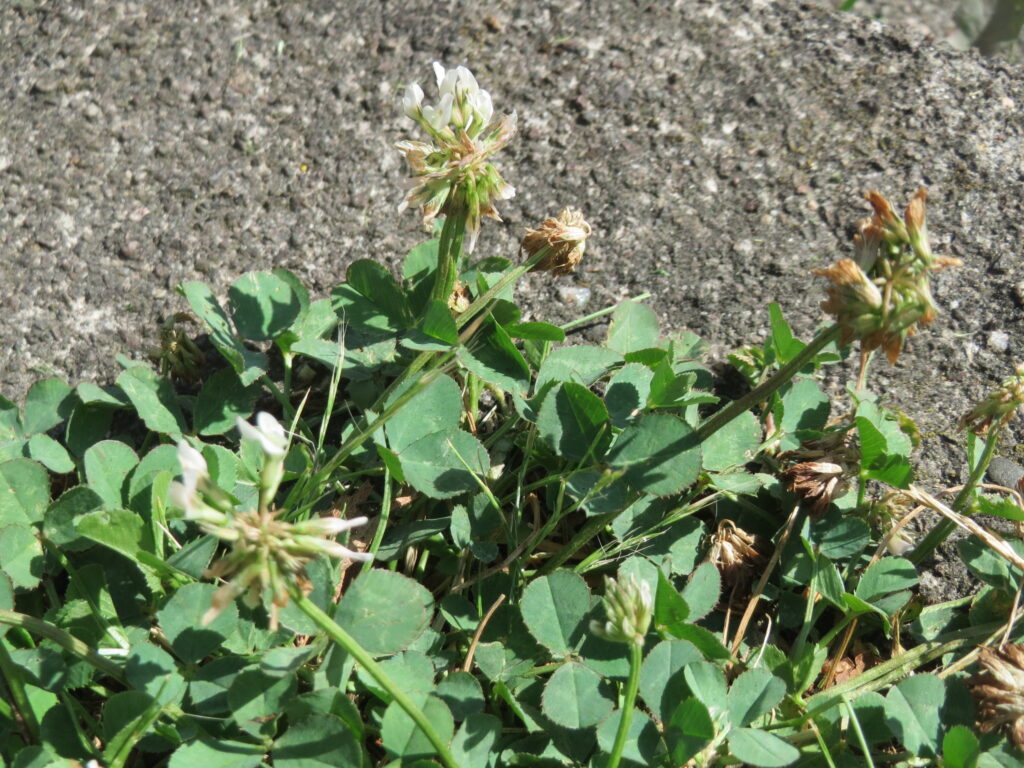
White clover (Trifolium repens) is among the commonest plants of lawns, pastures, and verges, and one of the easiest to recognise once its low, creeping habit is noted. The combination of rounded trifoliate leaves, white globe-shaped flower heads on long stalks, and stems that root as they spread separates it cleanly from the taller, hairier red clover.
A creeping habit
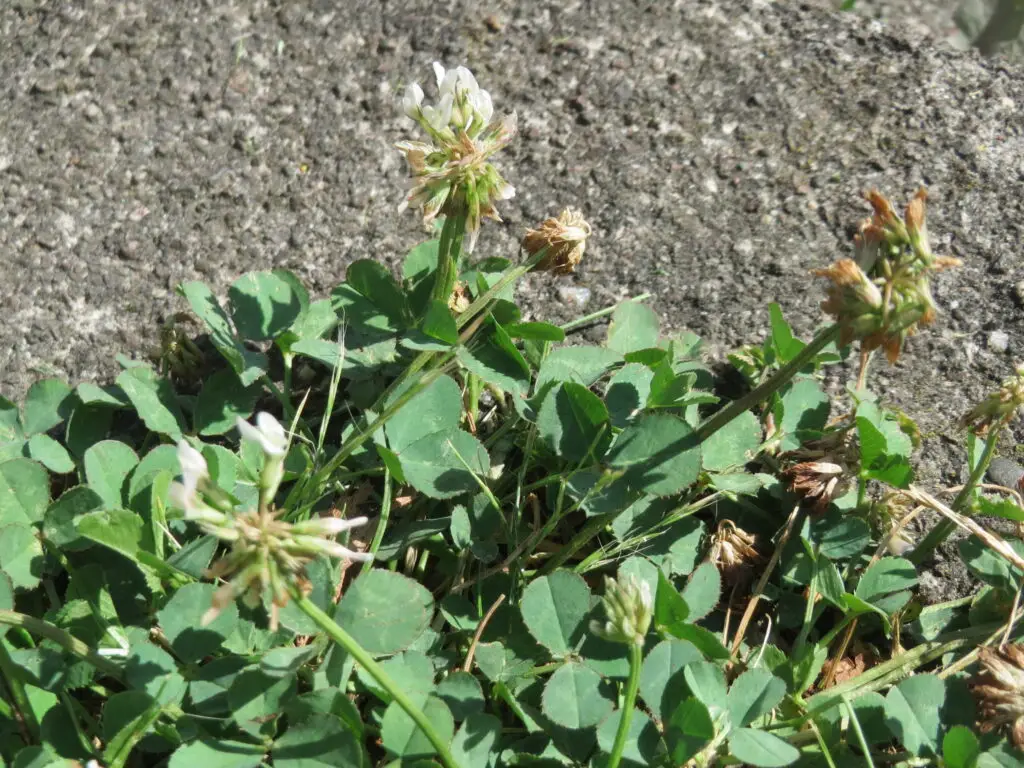
The defining feature of white clover is the way it grows. Rather than standing upright, it spreads horizontally by means of creeping stems, or stolons, that run along the ground and root at the nodes, sending up leaves and flower stalks as they go. This is why white clover forms broad, mat-like patches and survives close mowing so well. Red clover, by contrast, grows upright and does not root along the stem.
Leaves
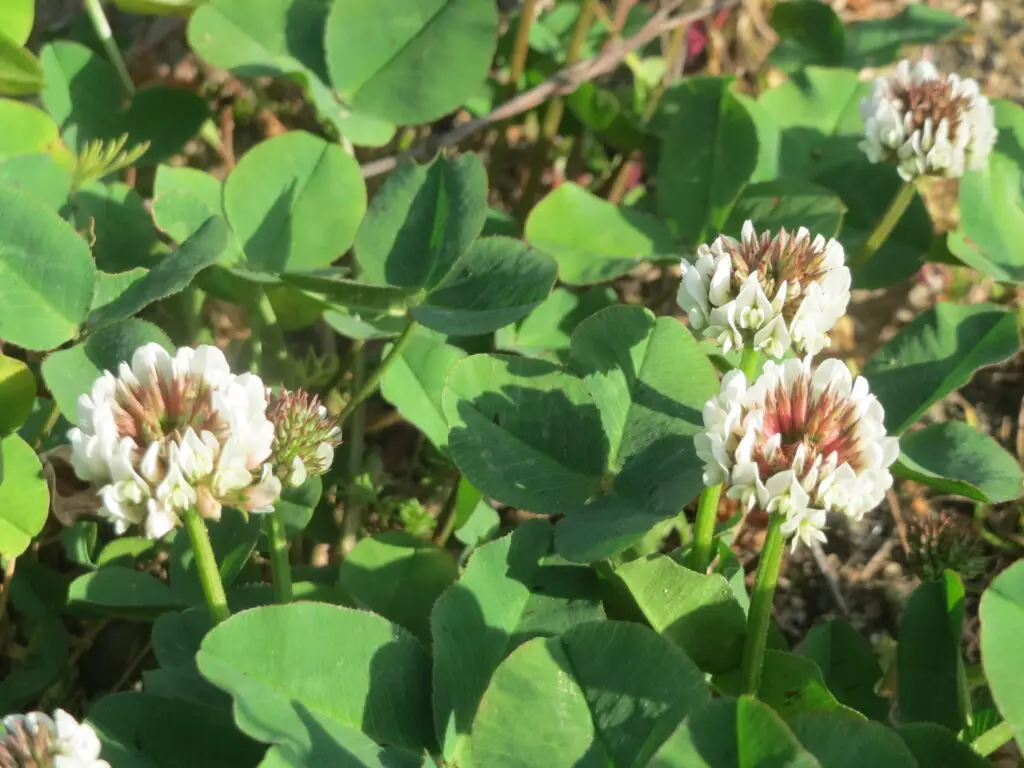
The leaves are trifoliate, with three rounded, obovate leaflets that are hairless and finely toothed at the margins, often with a small notch at the tip. Most leaflets carry a pale, whitish watermark, typically a rounded band or crescent rather than the sharp chevron usually seen in red clover. The leaves are carried on long stalks rising directly from the creeping stems.
Flower heads
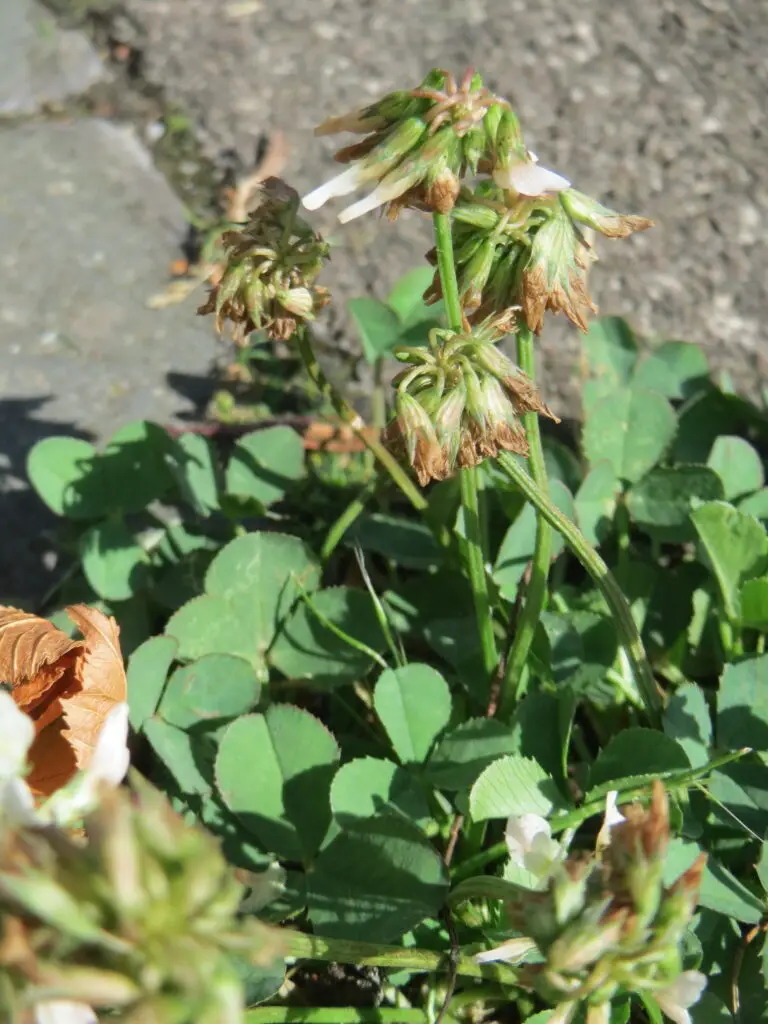
The flowers are grouped into dense, globe-shaped heads about one and a half to two centimetres across, made up of many small white pea-flowers that often take on a pinkish-brown tinge as they age and turn downward. Crucially, each head is raised on a long, leafless stalk that rises from the creeping stem, quite unlike the stalkless reddish heads of red clover that sit directly above a pair of leaves. The flowers are strongly scented and much visited by bees.
A reliable rule
Identify white clover by the combination of creeping, rooting stems, rounded hairless trifoliate leaves with a pale watermark, and white globe-shaped flower heads on long bare stalks. Upright hairy stems and stalkless pink-purple heads indicate red clover instead. As with any wild plant, confirm more than one feature, and never consume a plant you cannot name with certainty.
White clover vs red clover
| Feature | White clover (T. repens) | Red clover (T. pratense) |
|---|---|---|
| Growth habit | Creeping; roots at the nodes, mat-forming | Upright to ascending, branching |
| Stems | Hairless | Noticeably hairy |
| Leaf watermark | Pale, rounded, band-like | Pale, distinct V-shaped chevron |
| Flower colour | White, ageing pink-brown | Pink to reddish-purple |
| Flower head | On a long, leafless stalk | Stalkless, above a pair of leaves |
| Typical height | Creeping; flower stalks to about 15 cm | About 20-60 cm |
| Habitat | Lawns, pastures and verges | Meadows, verges and rough grassland |
References
Iowa State University (n.d.) ‘Dutch White Clover’. Natural Resources. Available at: https://naturalresources.extension.iastate.edu/encyclopedia/dutch-white-clover (Accessed: 27 June 2026).
Michigan State University (n.d.) ‘White clover – Trifolium repens’. Plant & Pest Diagnostics. Available at: https://www.canr.msu.edu/resources/white-clover-trifolium-repens (Accessed: 27 June 2026).
Wikipedia (n.d.) ‘Trifolium repens’. Available at: https://en.wikipedia.org/wiki/Trifolium_repens (Accessed: 27 June 2026).
Practical Self Reliance (n.d.) ‘Foraging White Clover (Trifolium repens)’. Available at: https://practicalselfreliance.com/foraging-white-clover-trifolium-repens/ (Accessed: 27 June 2026).
0 Comments
Join the conversation
Log in or create a free account to share your thoughts and vote on comments.
No comments yet — be the first to share your thoughts.