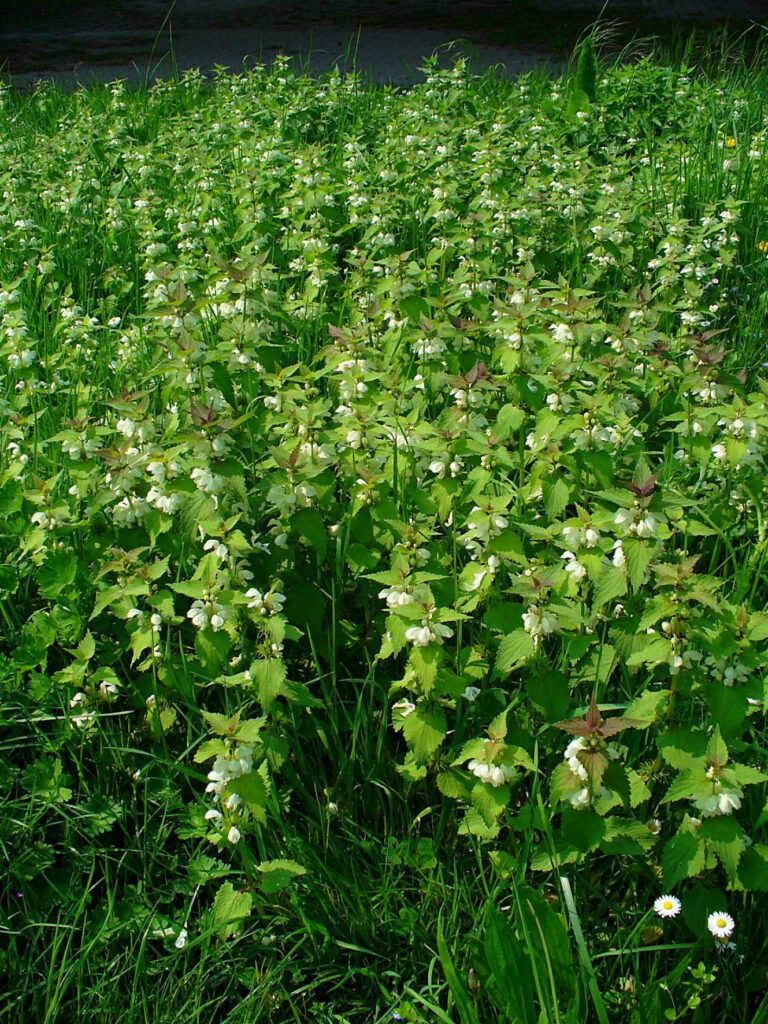
Common Names: White dead-nettle, white dead nettle, bee nettle, dumb nettle
Genus: Lamium
Parts Used: Flower, Leaf, Aerial parts
Medicinal Actions: Astringent, Anti-inflammatory, Antioxidant, Expectorant, Vulnerary (wound healing)
Preparation Methods: Cooked, Tea/Infusion, Tincture
Summary:
White dead nettle (Lamium album) is a common perennial of the mint family that closely resembles the stinging nettle but lacks any sting, hence the name “dead-nettle” (The Wildlife Trusts, n.d.). Long valued in European folk medicine, its white flowers and leaves are used as a mild astringent and anti-inflammatory for menstrual complaints, catarrh and minor wounds, and the young shoots are edible (Grieve, 1931; Francis-Baker, 2021). It is also an important early-season nectar source for bees and other long-tongued insects (The Wildlife Trusts, n.d.).
Distribution:
Native throughout Europe and temperate Asia, from Ireland in the west to Japan in the east, and widely naturalised in North America (Royal Botanic Gardens, Kew, n.d.). It grows on moist, fertile soils in a range of habitats including roadside verges, hedgerows, grassland, woodland edges and disturbed or waste ground (Royal Horticultural Society, n.d.; The Wildlife Trusts, n.d.). It is common across the Baltic region and throughout Latvia wherever the ground has been disturbed (The Wildlife Trusts, n.d.).
Notes:
White dead nettle is a rhizomatous herbaceous perennial growing to around 70–80 cm tall, with square stems and softly hairy, toothed, heart-shaped leaves arranged in opposite pairs (Royal Horticultural Society, n.d.; The Wildlife Trusts, n.d.). The white, hooded flowers are borne in whorls around the upper part of the stem and appear from March to December (The Wildlife Trusts, n.d.). The flowers are rich in polyphenolic and flavonoid glycosides such as verbascoside, tiliroside and the quercetin and kaempferol 3-O-glucosides (Budzianowski and Skrzypczak, 1995). They also contain iridoid glycosides including lamalbid, alboside A and B and caryoptoside, which are thought to contribute to the plant’s antioxidant and anti-inflammatory activity (Damtoft, 1992). Traditionally the flowering tops are taken as an infusion or tincture as an astringent and expectorant for catarrh and for excessive menstrual or vaginal discharge (Grieve, 1931). The young leaves and shoots can be cooked and eaten as a green vegetable (Francis-Baker, 2021).
Identification in the Wild:
White dead nettle is most reliably identified by combining several features at once. Like all members of the mint family it has a distinctly square stem in cross-section, and these hollow stems are strengthened at the corners by strong fibres (Ballyrobert Gardens, n.d.; Botanical Society of Scotland, 2022). The soft, hairy, heart-shaped and coarsely toothed leaves are stalked and arranged in opposite pairs up the stem, closely resembling those of the stinging nettle but bearing no stinging hairs, so the plant can be handled freely (Botanical Society of Scotland, 2022; Royal Botanic Gardens, Kew, n.d.). The clearest confirmation comes from the flowers: pure white, two-lipped (bi-labiate) blooms roughly 1.8u20132.5 cm long with a hooded upper lip, carried in whorls around the upper stem where the leaves meet it (First Nature, n.d.; Royal Horticultural Society, n.d.). Before the flowers open it is genuinely easy to confuse it with the stinging nettle, and to a lesser extent with other dead-nettles and even young foxglove rosettes, so it is safest to confirm the plant in flower; the white flowers, the absence of any sting and the square stem together rule out the stinging nettle, while the white (rather than reddish-purple) flowers separate it from red dead nettle, Lamium purpureum (First Nature, n.d.; Gardenersu2019 World, 2024). It typically grows as creeping clonal patches rarely taller than about 30u201350 cm, spreading by rhizomes and stolons along disturbed ground (Botanical Society of Scotland, 2022).
When to Collect:
For both teas and tinctures the part to target is the flowering tops, since the flowers (Lamii albi flos) are the richest source of the plantu2019s active constituents u2013 the iridoid glycosides such as lamalbid, the phenylpropanoid verbascoside, phenolic acids like chlorogenic acid, and flavonoids including rutin and tiliroside (Pietrzak and Nowak, 2020). These are the markers used to standardise medicinal flower extracts, so collecting the plant when the flowers are most abundant gives the most potent material (Pietrzak and Nowak, 2020). In practice this means harvesting the aerial parts when the plant is in full bloom, which across the Baltic and wider European range falls roughly from May to August (Ask-Ayurveda, n.d.; Herbal Reality, n.d.). White dead nettle flowers over a long season, so a stand can often be picked more than once through the summer. It is best gathered in mid-morning on a dry day, once the dew has evaporated but before the midday heat, which keeps the delicate flowers and their volatile constituents intact (Ask-Ayurveda, n.d.). The flowering tops can be used fresh u2013 ideal for tincturing while the aromatic compounds are still present u2013 or dried promptly in a single layer out of direct sunlight for teas and longer storage (Herbal Reality, n.d.).
Cultural Notes:
Because it grows side by side with the stinging nettle yet does not sting, white dead nettle has long been a familiar hedgerow and roadside plant in northern Europe, sometimes called the “bee nettle” for the bumblebees and other long-tongued insects it attracts (The Wildlife Trusts, n.d.). An old herbal tradition held that a distillation of the flowers would “make the heart merry” and brighten the complexion, and children have traditionally sucked nectar from the base of the flowers (Grieve, 1931). In Latvian and broader Baltic folk practice it is gathered as a spring potherb and a gentle remedy for women’s complaints (Grieve, 1931; The Wildlife Trusts, n.d.).
Safety Notes:
Generally regarded as safe in culinary amounts and at normal medicinal doses, and unlike the stinging nettle it has no stinging hairs (The Wildlife Trusts, n.d.). As with any traditional astringent, medicinal use during pregnancy or breastfeeding should be approached cautiously, and care should be taken to distinguish it correctly from similar species before foraging (Grieve, 1931; Francis-Baker, 2021). Clinical evidence for its medicinal effects is limited, so it should not replace conventional treatment for serious conditions.
References:
Ask-Ayurveda (n.d.) u2018Lamium album (White Dead-Nettle) in Ayurveda u2013 Benefits, Uses, Medicinal Properties & Healing Applicationsu2019. Available at: https://ask-ayurveda.com/wiki/article/4805-lamium-album (Accessed: 6 June 2026).
Ballyrobert Gardens (n.d.) u2018Lamium albumu2019. Available at: https://www.ballyrobertgardens.com/products/lamium-album (Accessed: 6 June 2026).
Botanical Society of Scotland (2022) u2018Plant of the Week u2013 17 January 2022: the White Dead-nettle (Lamium album)u2019. Available at: https://botsocscot.wordpress.com/2022/01/16/plant-of-the-week-january-17th-2022-the-white-dead-nettle-lamium-album/ (Accessed: 6 June 2026).
Budzianowski, J. and Skrzypczak, L. (1995) ‘Phenylpropanoid esters from Lamium album flowers’, Phytochemistry, 38(4), pp. 997–1001. doi:10.1016/0031-9422(94)00727-B.
Damtoft, S. (1992) ‘Iridoid glucosides from Lamium album’, Phytochemistry, 31(1), pp. 175–178. doi:10.1016/0031-9422(91)83030-O.
First Nature (n.d.) u2018Lamium album, White Dead-nettle: identification, distribution, habitatu2019. Available at: https://www.first-nature.com/flowers/lamium-album.php (Accessed: 6 June 2026).
Francis-Baker, T. (2021) Concise Foraging Guide. The Wildlife Trusts. London: Bloomsbury, p. 48.
Gardenersu2019 World (2024) u2018Complete Guide to Dead Nettlesu2019. BBC Gardenersu2019 World Magazine. Available at: https://www.gardenersworld.com/plants/dead-nettles/ (Accessed: 6 June 2026).
Grieve, M. (1931) A Modern Herbal. London: Jonathan Cape. Available at: https://botanical.com/botanical/mgmh/n/netwhd11.html.
Herbal Reality (n.d.) u2018White Deadnettle (Lamium album): Benefits, Uses, Safetyu2019. Available at: https://www.herbalreality.com/herb/white-deadnettle/ (Accessed: 6 June 2026).
Pietrzak, W. and Nowak, R. (2020) u2018Lamalbid, Chlorogenic Acid, and Verbascoside as Tools for Standardization of Lamium album Flowers u2013 Development and Validation of HPLCu2013DAD Methodu2019, Molecules, 25(8), 1913. doi:10.3390/molecules25081913.
Royal Botanic Gardens, Kew (n.d.) ‘Lamium album L.’ Plants of the World Online. Available at: https://powo.science.kew.org/taxon/urn:lsid:ipni.org:names:448792-1 (Accessed: 6 June 2026).
Royal Horticultural Society (n.d.) ‘Lamium album (white deadnettle)’. Available at: https://www.rhs.org.uk/plants/9810/lamium-album/details (Accessed: 6 June 2026).
The Wildlife Trusts (n.d.) ‘White dead-nettle’. Available at: https://www.wildlifetrusts.org/wildlife-explorer/wildflowers/white-dead-nettle (Accessed: 6 June 2026).
0 Comments
Join the conversation
Log in or create a free account to share your thoughts and vote on comments.
No comments yet — be the first to share your thoughts.